Mastering Asphalt Shingle Replacement for Homeowners
30
Sep
2026
Author:
Scott Fox
Identifying the Need for Asphalt Shingle Replacement
Recognizing when your home needs a fresh roof is one of the most critical parts of property maintenance. Roof failure rarely happens overnight; instead, asphalt shingles send out distress signals long before major structural failure occurs.
Homeowners in Long Island and Queens often spot physical signs of decay after severe weather seasons. One of the earliest warning signs is shingle curling or cupping, where the edges turn upward or the middle bows out. This indicates that the shingle's asphalt backing is drying out and losing flexibility after years of solar radiation.
Another clear warning sign is heavy granule loss. Asphalt shingles are coated with fine mineral granules that protect the underlying asphalt matrix from harmful solar UV rays. Over time, as shingles age, these granules wash away into your gutters. If you clear your downspouts in Port Washington or Flushing and discover piles of dark, gritty material—what roofers playfully call "roof sand"—your roof's protective layer is wearing thin.
When shingles lose their granules, water can reach the wood beneath. Indoors, keep an eye out for ceiling water stains or small pinpricks of daylight showing through attic roof boards. Left unaddressed, hidden moisture leads to deck rot and a sagging roofline. If you notice a visible dip along the ridge or surface of your roof in Bayside, Locust Valley, or Manhasset, structural timber framing or plywood deck sheathing may be decaying.
Evaluating Lifespan Across Different Shingle Types
Understanding the expected lifespan of your roofing materials helps you budget effectively for asphalt shingle replacement. Not all asphalt shingles are built the same:
3-Tab Asphalt Shingles: These basic single-layer shingles feature cutouts that make them look like three separate pieces. They have an average lifespan of 15 to 20 years. Because they are lightweight, they carry wind resistance ratings of around 60 to 70 mph and are more prone to wind blow-offs during severe storms.
Architectural (Dimensional) Shingles: These thicker, multi-layered shingles create a textured, shadow-line appearance. They offer a 25 to 30 year expected lifespan, higher impact resistance, and wind ratings up to 110 to 130 mph.
Luxury (Designer) Shingles: Heavyweight, multi-laminated shingles designed to imitate natural slate or wood shakes can last 30 to 50 years with proper care and attic ventilation.
In areas prone to harsh freeze-thaw cycles and humid weather—such as Long Island and coastal Queens—roofing materials experience intense thermal stress. A shingle rated for 25 years in a mild climate might start showing wear around year 18 to 20. If you are noticing persistent leaks on older materials, consulting a specialist about Roof Repair Suffolk County NY can help determine if minor fixes will suffice or if a full overhaul is required.
Repair vs. Full Replacement: Making the Right Decision
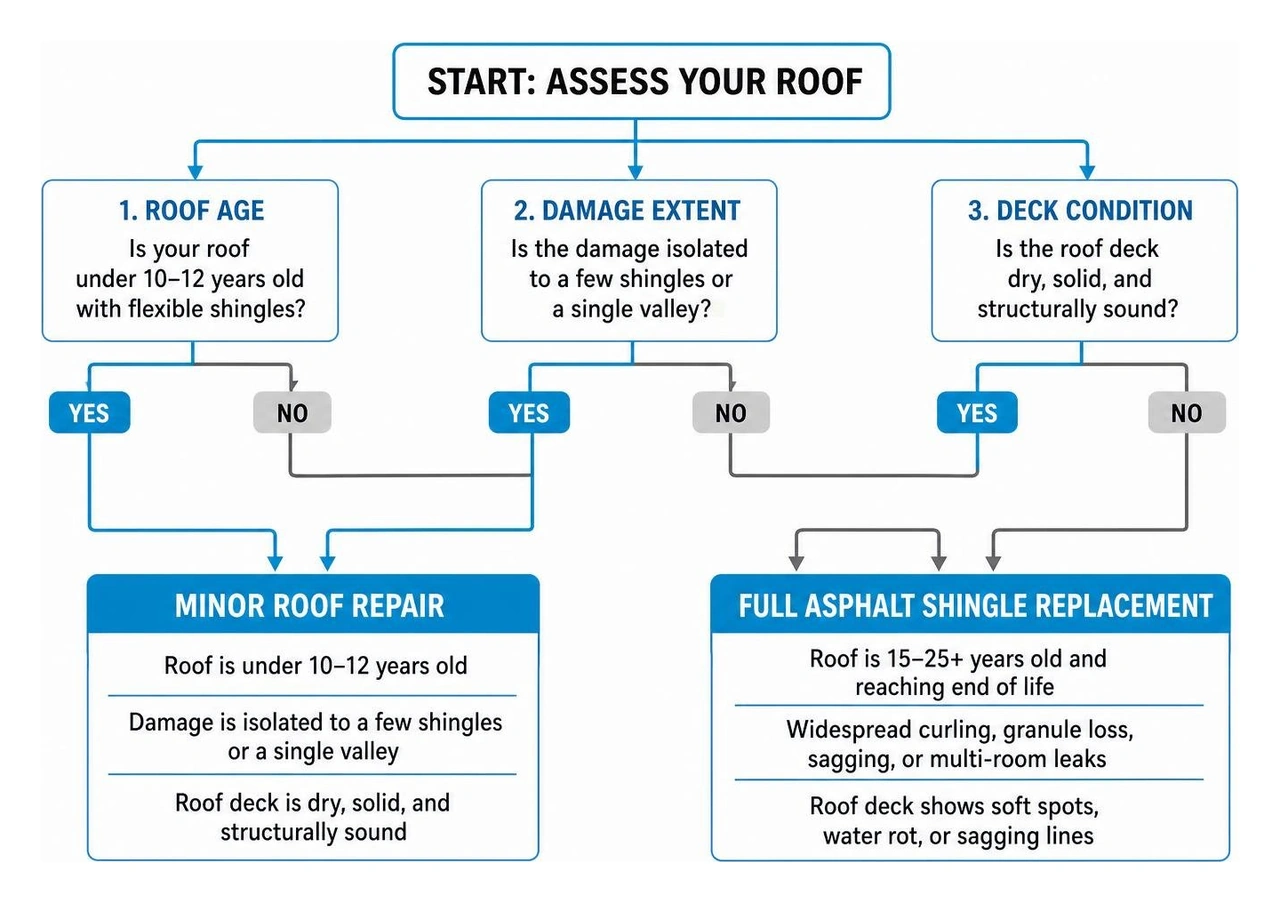
Deciding whether to patch up a damaged section or replace your entire roof usually comes down to three main factors: age, scope of damage, and total repair costs.
A helpful rule of thumb used in the roofing industry is the 30% rule: if damage affects more than 20% to 30% of your total roof surface, or if individual repair estimates exceed 30% of the cost of a complete replacement, investing in a full roof replacement is usually the better financial move.
Decision Factor
Minor Roof Repair
Full Asphalt Shingle Replacement
Roof Age
Roof is under 10–12 years old with flexible shingles.
Roof is 15–25+ years old and reaching end of life.
Damage Extent
Isolated to a few storm-damaged shingles or single valley.
Widespread curling, granule loss, sagging, or multi-room leaks.
Deck Condition
Plywood sheathing underneath is dry, solid, and structurally sound.
Plywood sheathing shows soft spots, water rot, or sagging lines.
Code Compliance
Existing roof consists of a single intact layer.
Roof already has two layers installed, reaching the legal limit.
Warranty & Value
Quick fix; does not alter existing roof system warranties.
Restores full property value and provides a brand-new material warranty.
If you own a home in Port Washington or Flushing that suffered isolated wind damage, swapping out a dozen shingles makes complete sense. However, patching an old, brittle roof often creates a domino effect: disturbing aged shingles during spot repairs can fracture surrounding materials, causing new leaks nearby.
Can You Install New Shingles Over Old Ones?
Homeowners often ask if they can save money by laying new shingles directly over an old layer—a process known as a "roof recover" or "overlay."
While most building codes allow up to two roof layers on residential structures, industry standards and experienced professional contractors strongly advise against overlays for several reasons:
Concealed Deck Damage: Installing shingles over an existing layer prevents contractors from inspecting the wooden decking below for hidden rot, water stains, or structural weakness.
Excess Weight: Asphalt shingles weigh roughly 250 to 400 lbs per roofing square (100 sq. ft.). Adding a second layer puts heavy structural strain on older rafters and trusses in Bayside and Locust Valley homes.
Trapped Heat: An old layer beneath new shingles traps solar heat, causing the top layer to bake, curl, and deteriorate much faster.
Voided Warranties: Many major shingle manufacturers limit or void their high-wind and defect warranties when new materials are installed over old laminated shingles.
A complete tear-off is almost always the smarter investment because it gives your roof a clean slate and guarantees every component underneath is fully sound.
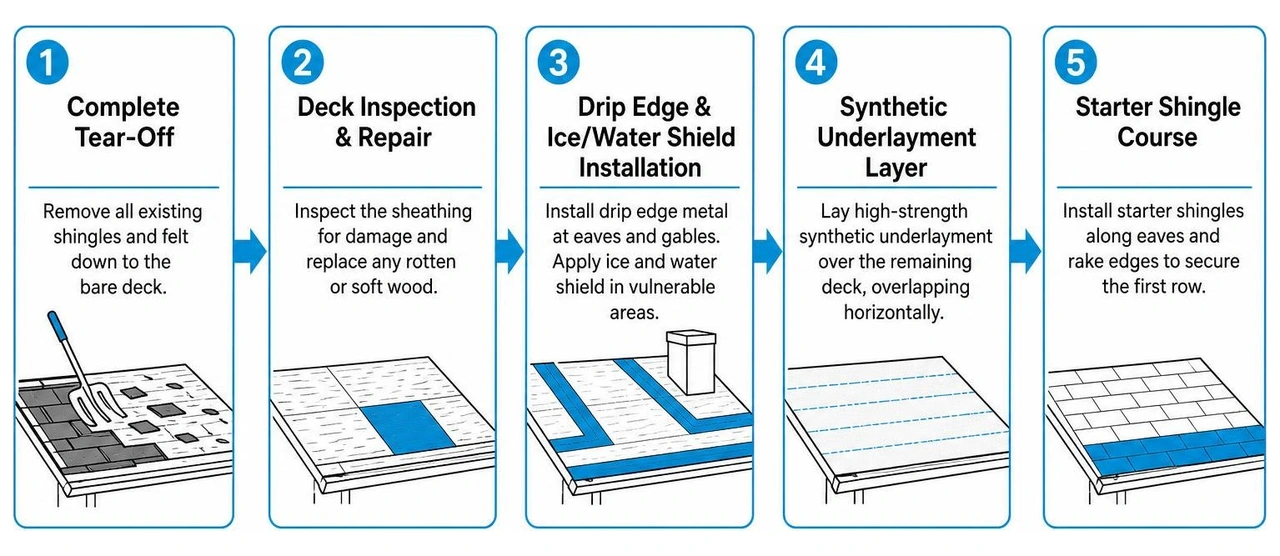
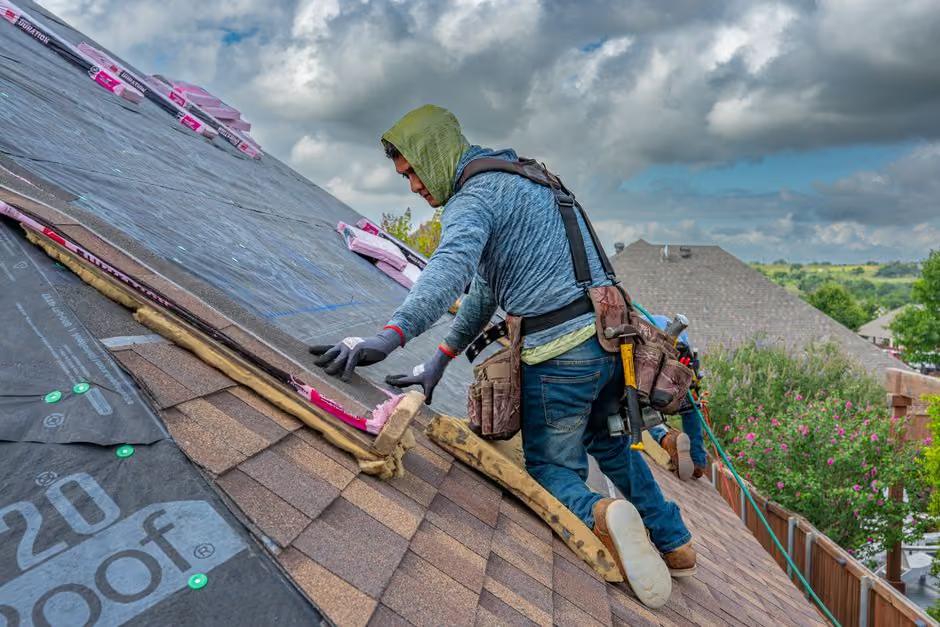
Installing a high-performance roof is a systematic process requiring specialized tools, strict safety controls, and proven installation practices. Here is how a professional crew completes an asphalt shingle replacement project:
Complete Tear-Off: Mechanics remove all existing layers of shingles and old felt down to the bare wooden deck using specialized tear-off forks and shovels.
Deck Inspection & Repair: The bare sheathing is thoroughly checked for rot, soft spots, or delamination. Damaged plywood or board sheathing is cut out and replaced with fresh, code-compliant wood panels.
Drip Edge & Ice/Water Shield Installation: Corrosion-resistant drip edge metal is installed along eaves and gables. Self-adhering ice and water shield membranes are applied directly to the deck along eave edges, valleys, and around chimneys to protect against ice damming.
Synthetic Underlayment Layer: High-strength synthetic underlayment is laid across the remaining roof deck, overlapping horizontal courses to form a second line of defense against wind-driven rain.
Starter Shingle Course: Starter shingles featuring factory-applied adhesive strips are installed along eaves and rake edges to secure the first row of shingles against wind uplift.
Field Shingle Application: Architectural shingles are laid upward from eave to ridge using code-specified offset patterns. Installers drive four to six galvanized roofing nails per shingle directly through the designated nailing line.
Flashing & Penetrations: Step flashing, apron flashing, and rubber pipe boots are integrated into the shingle courses around chimneys, sidewalls, skylights, and plumbing vents.
Ridge Caps & Ventilation Installation: Ridge vents are fitted along peak lines to ensure continuous attic airflow, then capped with specialized hip and ridge shingles.
Site Cleanup & Magnetic Sweep: The perimeter is cleared, gutters are flushed, and powerful rolling magnets are swept across lawn and driveway areas to pick up loose roofing nails.
Preparing for Your Asphalt Shingle Replacement Project
A full roof replacement is a dynamic, high-energy construction event. Proper preparation ensures that installation day proceeds smoothly for your household in Manhasset or Queens.
Prior to arrival, the installation team coordinates local municipal permits and arranges for a debris container (dumpster) to be dropped off in your driveway. To protect your property:
Move Vehicles: Park all cars, trucks, and boats well away from the house perimeter and out of driveway access paths.
Clear Outdoor Areas: Relocate patio furniture, lawn ornaments, grills, and potted plants away from wall lines to prevent accidental damage from falling debris.
Secure Indoor Belongings: Hammering on roof rafters creates vibrations throughout the house. Remove delicate picture frames, wall hangings, and glass items on upper floors.
Protect the Attic: Cover storage boxes or furniture inside unfloored attics with drop cloths, as tiny wood chips and dust can drift through board gaps during tear-off.
Coordinate Pets and Children: Roof replacements can be noisy; setting up a quiet interior space or planning an outing keeps kids and pets comfortable.
If you are planning a project, review our options for Shingle Roofing Installation Service NY to understand how we set up protective tarping and ground covers around flower beds and shrubbery.
Cost Factors, Insurance Coverage, and Contractor Selection
Understanding how roof replacement costs are calculated helps you plan your home improvement budget with confidence.
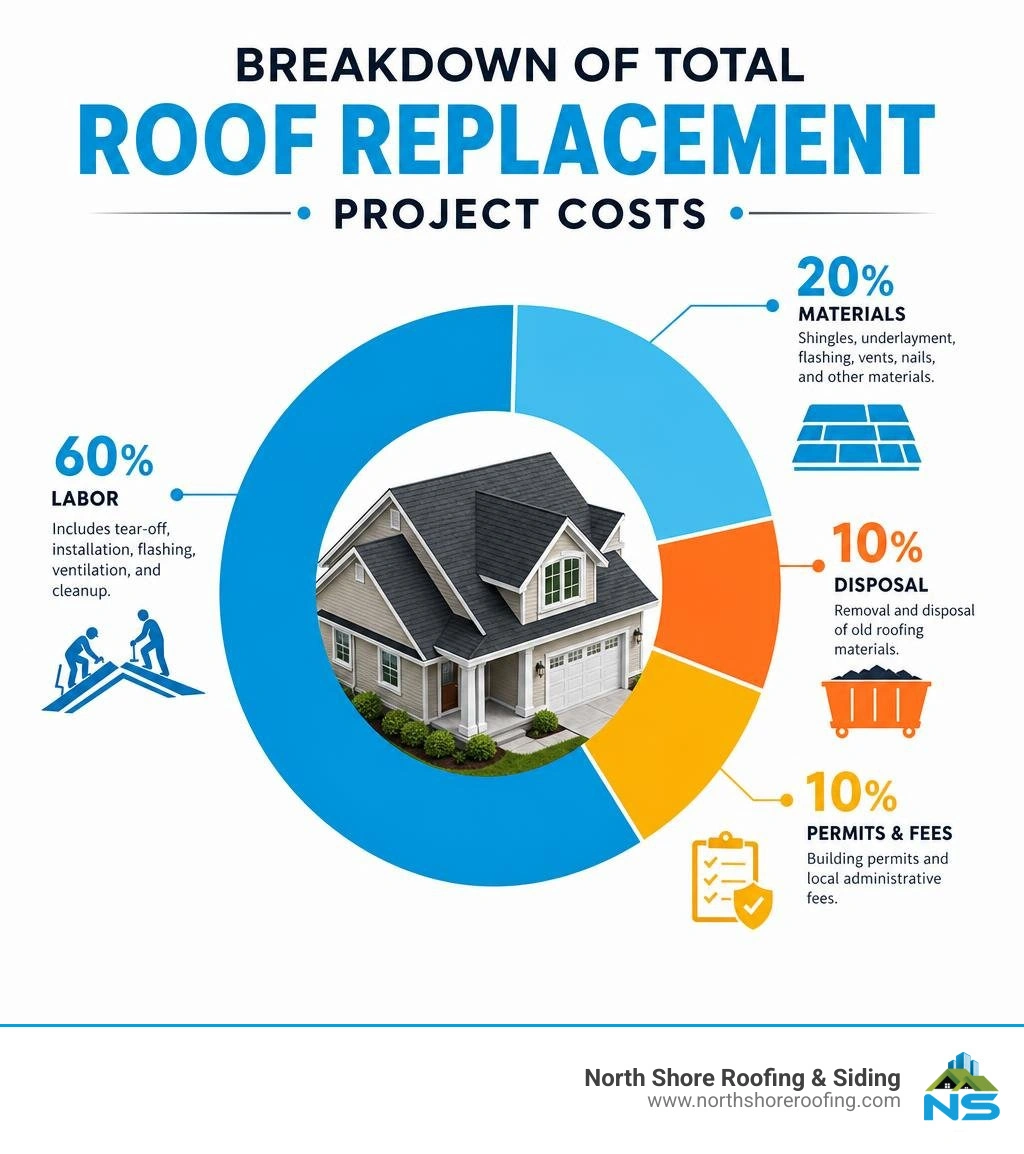
Labor represents roughly 60% of total roof replacement costs, with raw materials, disposal, and administrative permit fees making up the remaining 40%. The overall cost of an asphalt shingle replacement project is influenced by several core elements:
Roof Size and Complexity: Roofing projects are priced by the "square" (100 square feet of surface area). Dormers, hips, valleys, and multiple roof angles increase both waste factors and required labor hours.
Roof Pitch (Steepness): Roofs with steep slopes (e.g., pitches of 7/12 or higher) require specialized scaffolding, roof brackets, and extra safety equipment, which increases labor setup time.
Material Selection: Standard 3-tab shingles are the most budget-friendly upfront ($3.40 to $4.65 per sq. ft. installed), whereas architectural shingles ($4.11 to $5.57 per sq. ft.) and designer options ($5.00 to $8.00+ per sq. ft.) carry higher material costs due to their enhanced durability.
Tear-Off and Disposal Fees: Stripping old shingles and disposing of heavy waste typically adds $0.39 to $0.53 per square foot per layer removed.
Deck Sheathing Repairs: Replacing rotted plywood sheathing generally costs between $2.20 and $3.00 per square foot ($50 to $100 per 4x8 sheet) depending on timber supply pricing.
Pricing for roof work reflects regional labor rates, freight costs, and local municipal permit fees. Across suburban Long Island and coastal areas like Port Washington, Flushing, Bayside, Locust Valley, and Manhasset, average overall costs for a typical 1,700-to-2,000-square-foot roof range between $6,000 and $12,500, with architectural shingle installations averaging around $9,000 to $10,500.
When evaluating your property, a new roof offers a strong return on investment (ROI)—often recovering over 60% of its initial cost in added home equity, while lowering cooling bills during hot summers in Queens.
Selecting the right roofing company is just as important as choosing high-quality shingles. To ensure you hire an experienced, fully licensed team:
Verify Credentials: Ensure the business holds full municipal licensing and carries active General Liability and Workers' Compensation insurance.
Demand Written Line-Item Quotes: Never rely on verbal estimates. Written proposals should specify the exact shingle brand, underlayment type, ice/water barrier coverage, drip edge style, and per-sheet wood replacement costs.
Understand Payment Schedules: A reasonable deposit ranges from 10% to 33% upfront to cover job materials. Be cautious of contractors demanding full payment before work begins.
Evaluate Warranty Details: Confirm that your contractor offers both a Manufacturer Material Warranty (typically 25 years to lifetime limited) and an explicit Workmanship Warranty covering installation quality.
Working with reputable Roofing Companies Long Island ensures that your installation complies with local building codes, high-wind zone mandates, and manufacturer standards.
A typical residential asphalt shingle replacement project for a single-family home takes between 1 and 3 days to complete. Simple single-story gable roofs can often be completed in a single day by an experienced, full-size crew.
More complex multi-story structures in Long Island or Queens featuring steep slopes, multiple dormers, and intricate valley systems may require 3 to 5 days. Weather conditions, such as sudden wind or rain storms, can also extend installation timelines.
Does homeowners insurance cover roof replacement costs?
Homeowners insurance policies generally cover roof replacement costs if the damage is caused by sudden, unpreventable events (covered perils)—such as severe windstorms, hail, or falling tree branches. Insurance generally does not cover replacement if roof failure is due to routine age, deferred maintenance, or gradual wear and tear.
When filing a claim, check whether your policy provides Replacement Cost Value (RCV) or Actual Cash Value (ACV):
RCV Policies: Cover the full cost to repair or replace the damaged roof with materials of similar quality, minus your deductible.
ACV Policies: Depreciate the payout based on the age and condition of your roof at the time of loss. (Many insurance carriers transition older roofs—typically around 15 to 20 years of age—from RCV to ACV coverage automatically).
How can I extend the lifespan of my asphalt shingle roof?
Proactive maintenance keeps your shingles working at peak performance and helps prevent premature decay:
Keep Gutters Clean: Clear leaves, needles, and debris from gutters twice a year to ensure water drains freely and can't back up under eave shingles.
Trim Overhanging Branches: Cut back tree branches within 6 to 10 feet of your roofline to prevent scraping during high winds and reduce shade that encourages moss growth.
Ensure Balanced Attic Ventilation: Pair soffit intake vents with ridge exhaust vents to maintain a steady flow of cool air through your attic space. Proper airflow lowers attic temperatures in summer and prevents ice dams in winter across Port Washington, Flushing, Bayside, Locust Valley, and Manhasset.
Schedule Annual Visual Inspections: Inspect roof planes from the ground using binoculars after major storm events to catch missing shingles, disturbed flashings, or sealant gaps early before water enters your interior living space.
Conclusion
A durable roof is your home's first line of defense against nature. Investing in professional asphalt shingle replacement restores structural protection, reduces long-term maintenance worries, improves energy efficiency, and elevates curb appeal across Long Island, Queens, Port Washington, Flushing, Bayside, Locust Valley, and Manhasset.
Whether you are dealing with storm damage, persistent leaks, or shingles approaching the end of their design life, working with a certified team ensures your new roof is built right from the bare deck up.
At North Shore Roofing & Siding, our licensed installers use field-tested materials, honest pricing models, and meticulous craftsmanship to deliver beautiful results that withstand local weather. Contact us today to request a free, detailed inspection and estimate! Explore our Shingle Roofing Installation Services to protect your home for decades to come.
Get A Free Long Island & Queens Roofing & Siding Estimate Today
Ready to upgrade your roof, siding, or gutters? Enhance your property with a slate roof that delivers both beauty and long-term value. Contact us for a free, no-obligation estimate. Our roofing team is ready to help you protect your New York property with care, enduring beauty, and confidence. installation, repair, or replacement in Queens, Long Island, Bayside, Manhasset, Port Washington, or Locust Valley and surrounding areas.