Blog Content

18
Sep
2026
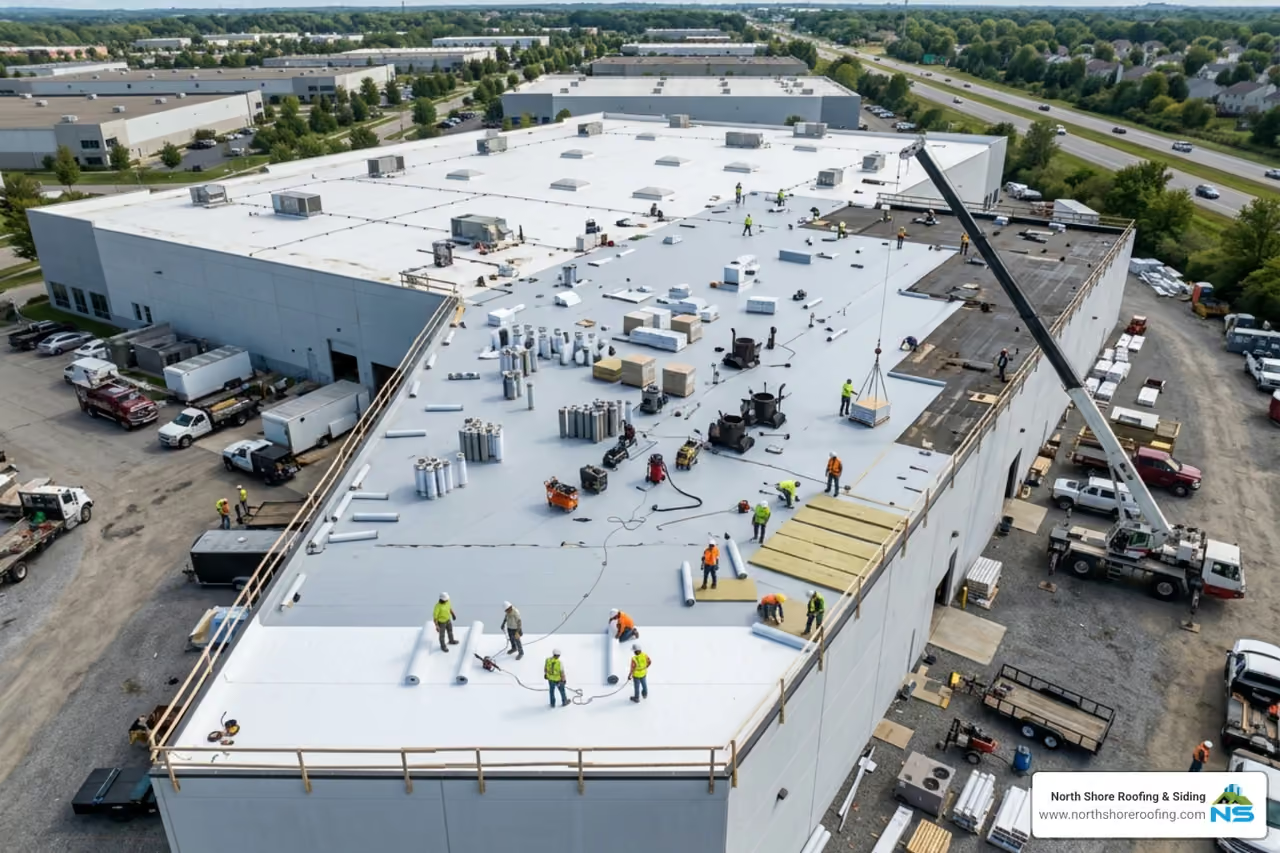
Commercial roof replacement cost is one of the largest capital expenses a building owner will face — and in the Long Island and Queens market, those numbers run higher than national averages.
Here is a quick snapshot before we go deeper:
Northeast regional premium adds 15–25% above national base rates. A 10,000 sq ft commercial roof in Port Washington, Flushing, Bayside, Locust Valley, or Manhasset will typically run $75,000–$130,000 depending on the system chosen.
Commercial roofing costs have also climbed 18–22% since 2021, driven by material price increases, skilled labor shortages, and tighter energy code requirements. That means a budget built even two years ago may no longer reflect reality.
Whether you manage a strip mall in Bayside, a warehouse in Queens, or an office building in Manhasset, understanding what drives these costs — before you call a contractor — puts you in a much stronger position to evaluate bids, avoid surprises, and protect your investment.
This guide breaks down every major cost factor, material option, and construction decision you need to make a smart call.
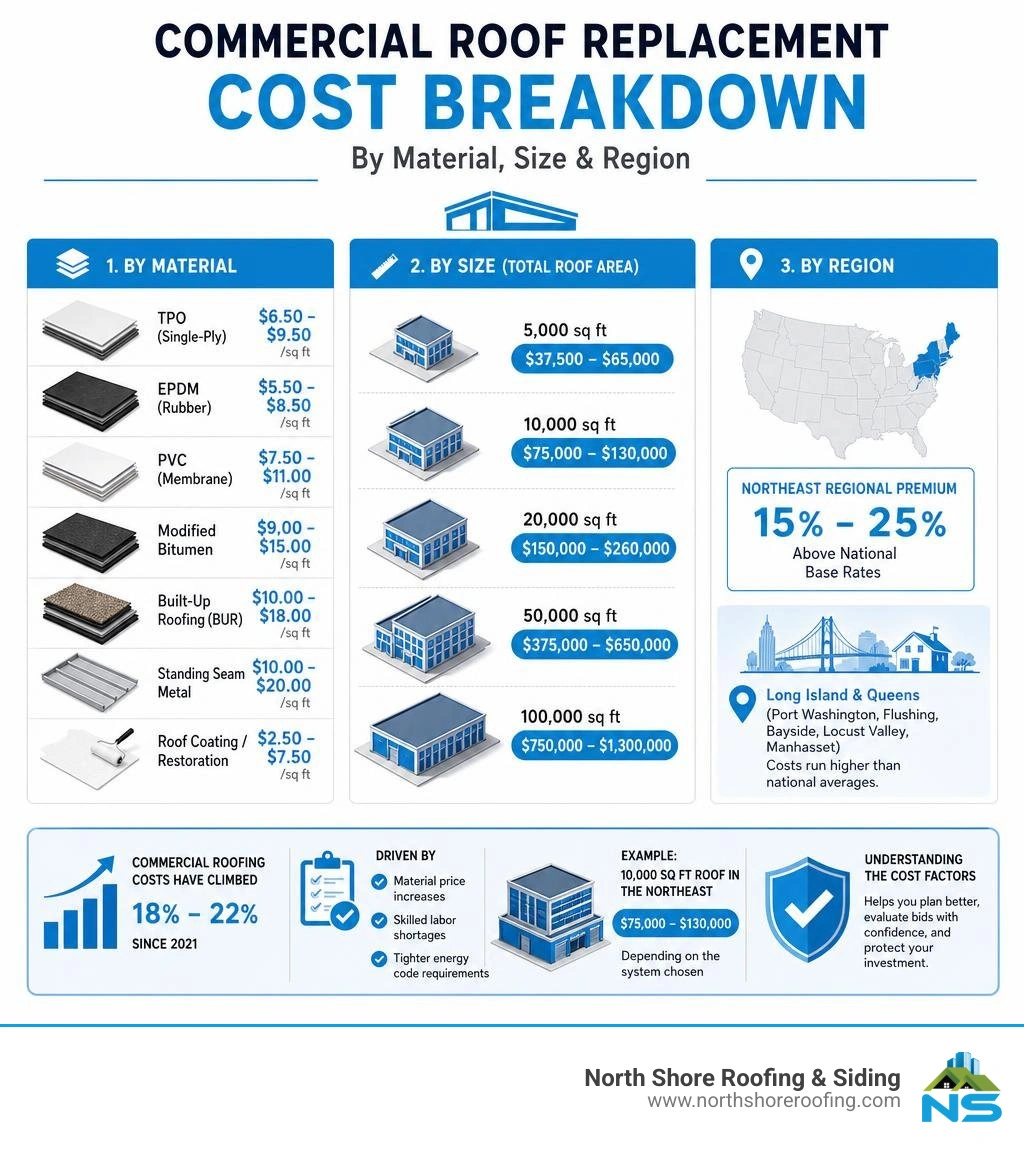
Commercial roof replacement cost terms explained:
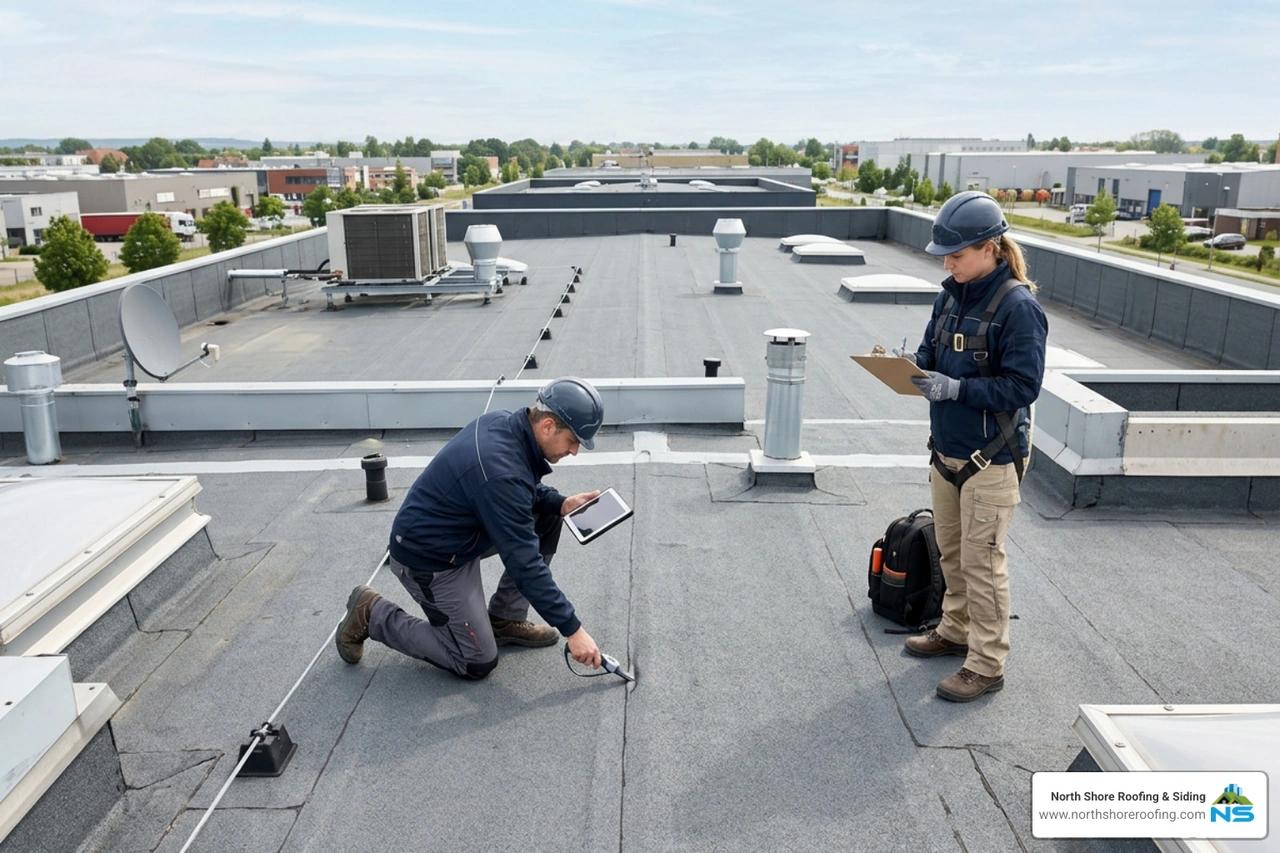
Calculating the commercial roof replacement cost is never as simple as multiplying the roof's square footage by a flat material rate. Commercial properties present unique architectural and environmental challenges that directly impact the bottom line. In the Northeast, and specifically across Long Island and Queens, these variables are amplified by dense urban layouts, coastal weather patterns, and strict regulatory standards.
Several primary factors dictate where your project will fall on the pricing spectrum:
The physical footprint and height of your building are major cost drivers. While larger roofs benefit from scale savings on material purchasing, the overall size increases the complexity of the installation. For example, a massive, low-profile warehouse in Queens has vastly different staging requirements than a multi-story office building in Flushing.
As building height increases, so does the cost of logistics. If we are replacing a roof on a four-story building in Bayside, we cannot simply carry materials up a ladder. We must budget for heavy equipment rentals:
Furthermore, if your building is occupied during construction, we must manage the operational impact. Scheduling noisy work (such as fastening insulation plates into a steel or concrete deck) during off-hours or weekends prevents disruption to offices, medical clinics, or retail spaces, but it introduces premium labor rates.
Operating in the New York metropolitan area means navigating some of the most rigorous building codes and highest labor rates in the nation. Whether your property is located in Queens County or Nassau County, local municipal codes dictate exactly how your roof must be built.
In Queens, we must comply with NYC Building Codes, which mandate specific fire-resistance ratings, cool roof reflectivity standards, and wind-uplift resistances. Long Island municipalities, from Hempstead to North Hempstead (including Port Washington and Manhasset), enforce their own localized zoning laws and permit processes.
These regulatory requirements directly influence material selection. For instance, NYC's "Cool Roof" mandates require highly reflective white membranes (like TPO or PVC) to reduce the urban heat island effect. If you are planning a project, working with an experienced local contractor is essential to ensure your permits are filed correctly and your system complies with all local energy conservation codes. You can learn more about local installation standards by reading about Commercial Roof Installation NY.
Selecting the right material is a balancing act between your upfront budget, the building's structural capabilities, and your long-term holding strategy for the property.
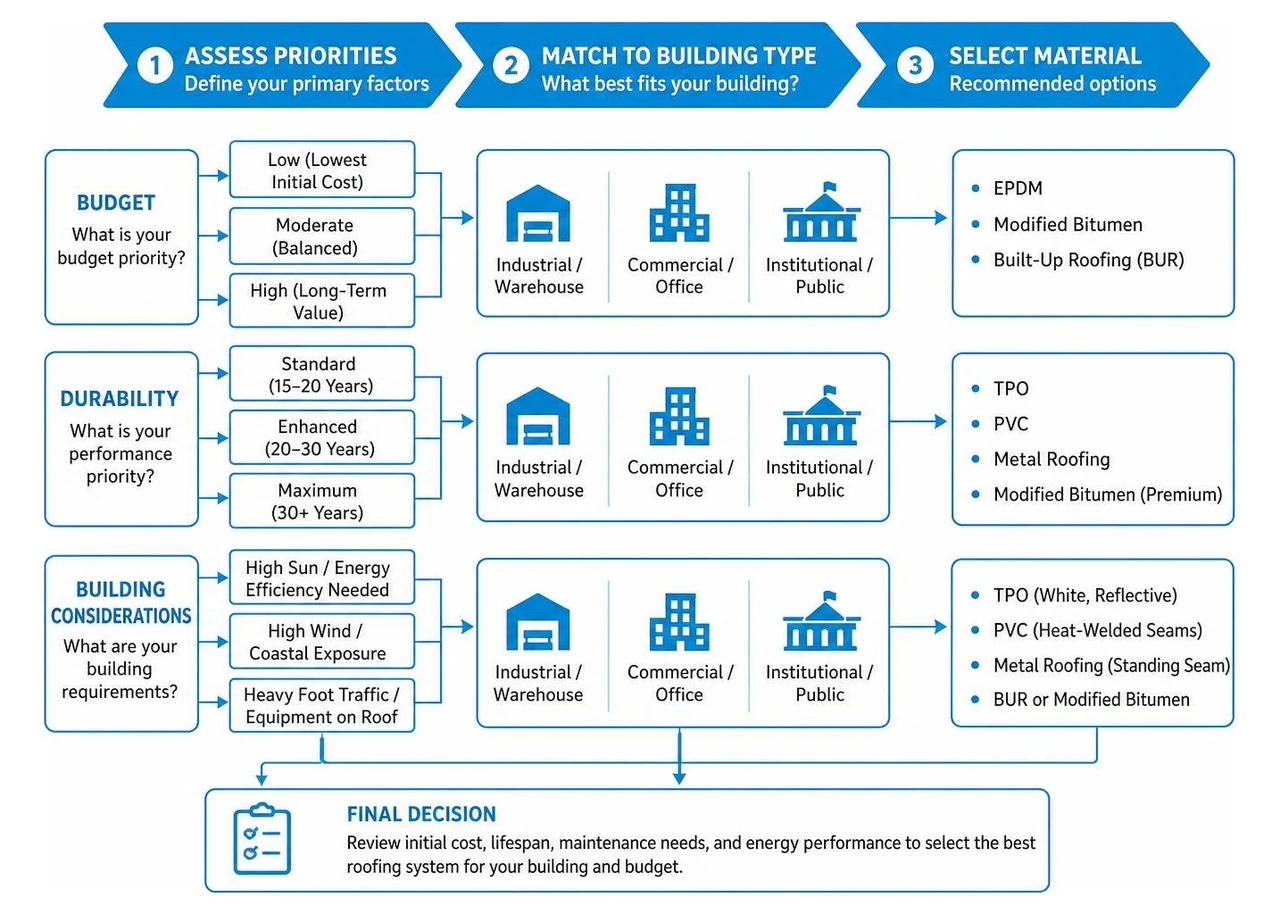
When analyzing the commercial roof replacement cost, it is wise to look at the 25-year Total Cost of Ownership (TCO). A system with a lower initial installation price might require frequent maintenance or suffer from a shorter lifespan, ultimately costing you more over a two-decade span than a premium system.
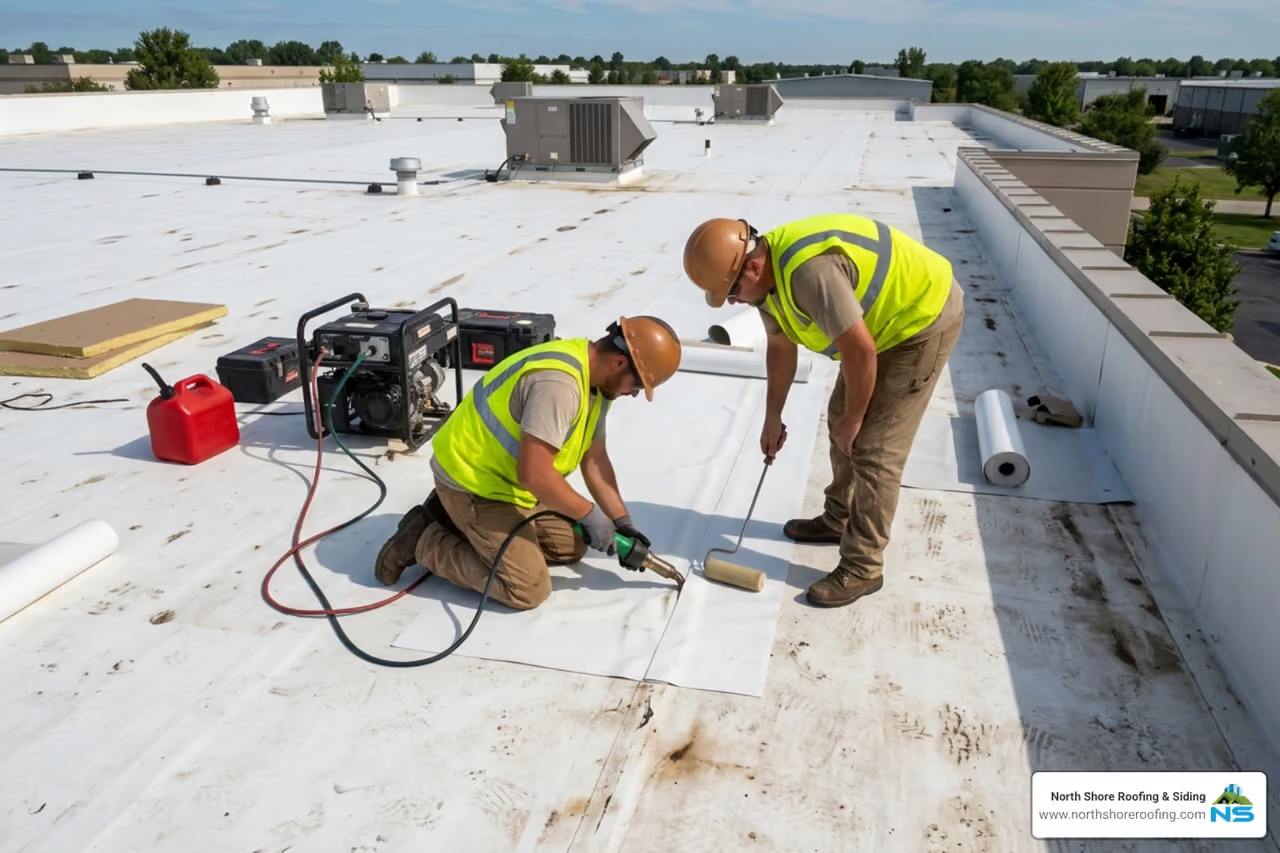
Single-ply membranes are the most popular flat-roofing choices in the United States today due to their lightweight design, cost-effectiveness, and reliable performance.
To explore single-ply options for flat surfaces in our region, review our specialized guide on Commercial Flat Roofing Installation NY.
For buildings with sloped roofs or those requiring heavy-duty, multi-layered protection, metal and asphalt-based systems remain highly viable options.
For a deeper dive into metal options, consult our Commercial Metal Roofing Guide 2026.
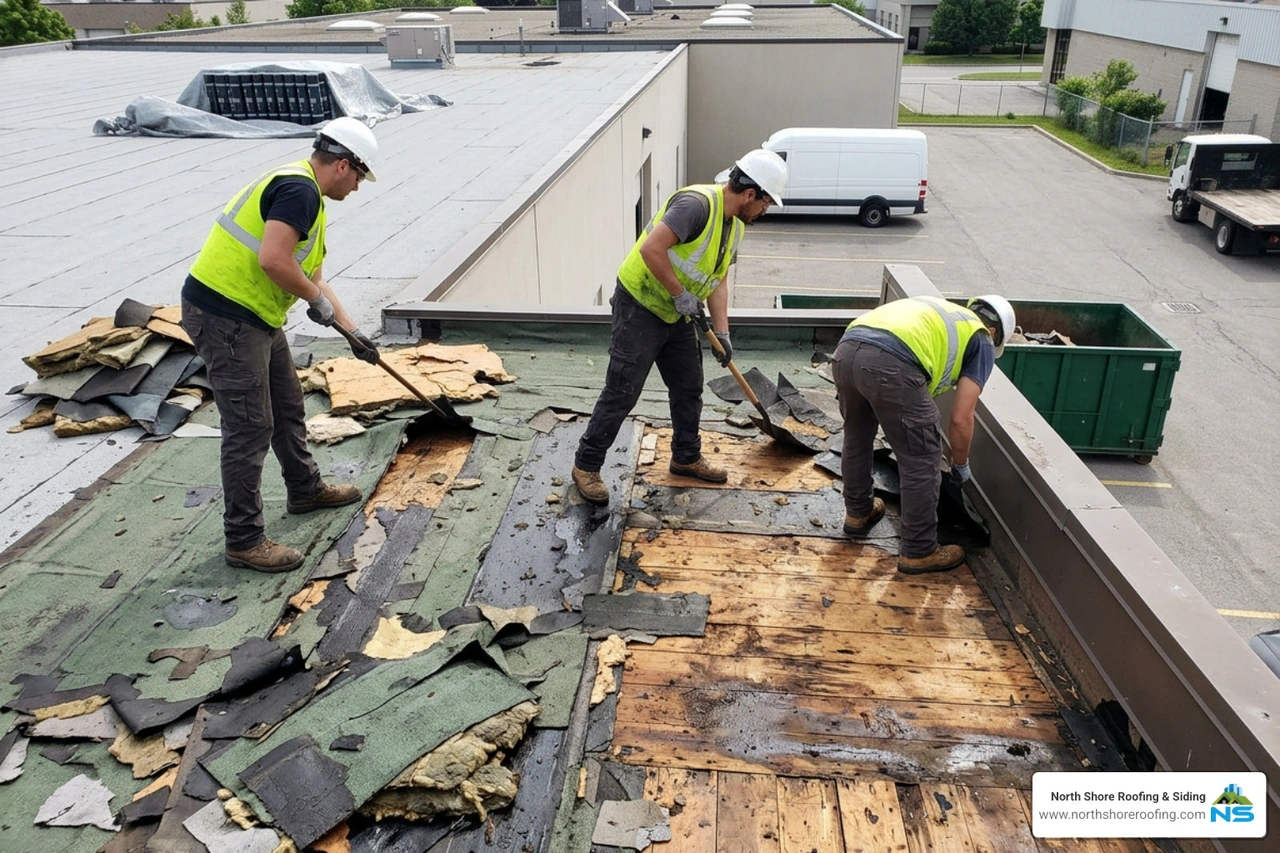
One of the most critical decisions affecting your commercial roof replacement cost is whether to perform a complete "tear-off" or an "overlay" (also known as a re-cover).
According to the International Building Code (IBC Section 1511.3), a building is permitted to have a maximum of two roofing layers. If your building already has two layers of roofing installed, a complete tear-off is legally mandated before any new roof can be laid down.
If you currently have only one layer, an overlay — where we lay down a thin recovery board over the existing membrane and install a new system on top — can save you 15% to 25% on total project costs by eliminating labor-intensive demolition and disposal fees. However, an overlay is only a viable option if a professional moisture survey (such as an infrared or nuclear scan) confirms that less than 25% of the existing insulation is wet. Installing a new roof over wet insulation traps moisture, leading to structural rot, mold, and rapid failure of the new membrane.
While a full tear-off is more expensive upfront, there are many scenarios where it is the only responsible engineering path:
For properties requiring heavy industrial-grade tear-offs and structural prep, learn more about our process for Industrial Roof Replacement.
If your roof membrane is aging but still structurally sound, and your insulation is completely dry, you may not need a replacement at all. A professional roof restoration using high-performance silicone or acrylic coatings can extend your roof's service life by 10 to 15 years at a fraction of the cost of a replacement.
Silicone coatings (such as Gaco or GE systems) cost $2.50 to $7.50 per square foot installed. They are applied directly over your existing clean membrane, creating a seamless, waterproof barrier that can withstand unlimited ponding water. Because they are highly reflective, they also deliver immediate energy savings by lowering roof surface temperatures. However, a coating will not fix wet insulation or structural deck damage — applying a coating over a failing roof is simply throwing money away. To compare these options further, read the comprehensive Commercial Roof Cost Guide (2026) | Commercial Roof Guide .
When budgeting for your project, it is vital to account for soft costs and potential hidden expenses that standard roofing bids might omit. In the Long Island and Queens markets, these hidden costs can quickly impact your capital budget if not anticipated:
To ensure your budget covers these logistical realities, you can review the extensive checklist provided in the Commercial Roof Replacement | Cost Per Sq Ft & Options | Roofs Wiki .
In 2026, the average cost for a full commercial roof replacement in the Long Island and Queens region typically ranges from $6.50 to $15.00 per square foot for flat single-ply systems (TPO, EPDM, PVC), and up to $20.00 per square foot for premium standing seam metal systems. This price includes a complete tear-off of one existing layer, installation of code-compliant R-30 insulation, the new membrane, and standard edge metal flashing.
For a standard 10,000 to 20,000 square foot commercial building, the physical installation on site usually takes two to three weeks, assuming cooperative weather. Our crews typically complete 5,000 to 10,000 square feet of membrane installation per day. To minimize business disruption, we often phase the work in sections, ensuring the building remains completely watertight at the end of every work day.
An NDL (No Dollar Limit) warranty is a manufacturer-backed warranty that covers the full cost of both materials and labor to repair any covered defects or leaks for a period of 10 to 30 years. Unlike standard pro-rated warranties, an NDL warranty does not deplete in value over time and is not capped by the original cost of the roof. For a nominal fee (typically $0.15 to $0.30 per square foot paid directly to the manufacturer for inspection and registration), an NDL warranty provides invaluable long-term financial protection for your commercial asset.
A commercial roof replacement is a complex, high-stakes project, but with the right planning, engineering data, and local expertise, it can be a smooth transition that protects your property and lowers your operating costs for decades.
At North Shore Roofing & Siding, we have spent decades serving commercial property owners across Long Island and Queens, from the bustling streets of Flushing and Bayside to the coastal communities of Port Washington, Manhasset, and Locust Valley. Our certified, fully insured team specializes in high-performance single-ply membranes, durable metal systems, and advanced silicone restorations. We believe in honest pricing, meticulous attention to detail, and delivering results that exceed your expectations.
If you are ready to stop guessing about your roof's condition and want an accurate, itemized estimate for your building, we are here to help. Contact us today to schedule a professional, drone-assisted roof assessment and infrared moisture survey. Let us help you protect your investment with a roof built to last. Learn more about our specialized local services by visiting our Commercial Roofing Services NYC page.

Copyright 2022 North Shore Roofing & Siding | All Rights Reserved | Sitemap | Website by Plumb Development a Digital Marketing Agency

