Blog Content

26
Aug
2026
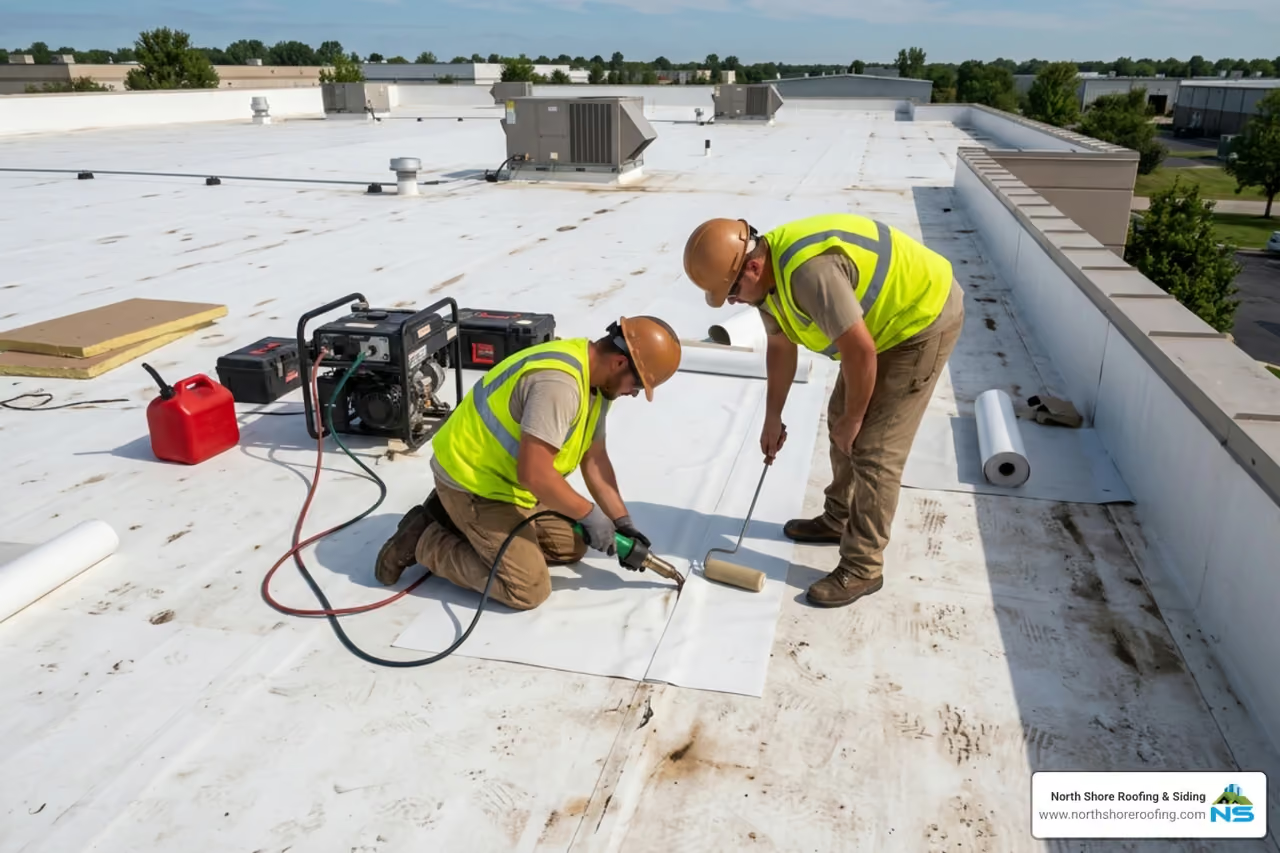
If you are dealing with a sudden leak or storm damage on your commercial flat roof, securing a professional tpo roof repair is the fastest way to protect your building and prevent costly structural damage.
To address a TPO leak immediately, professionals follow this standard repair protocol:
Flat roofs on Long Island and in Queens face unique local climate challenges. From intense summer sun in Port Washington and Manhasset to freezing winter coastal winds in Locust Valley, Flushing, and Bayside, these temperature swings cause single-ply membranes to expand and contract.
Over time, this movement puts immense pressure on your roof's seams.
At North Shore Roofing & Siding, we know that a failing flat roof can disrupt your entire business operations. Whether you are dealing with ponding water in Flushing, seam separation in Bayside, or storm damage in Port Washington, ignoring minor wear today can turn a simple patch job into an expensive full-system replacement tomorrow.
Because TPO membranes require highly specialized hot-air welding equipment and precise temperature controls, attempting a DIY fix with hardware-store caulks or asphalt-based cements will permanently ruin the chemical structure of the membrane and instantly void your manufacturer warranty.
To keep your business dry and your warranty active, trust our certified local team to handle your commercial flat roof maintenance. We have spent years serving business owners across Long Island and Queens, delivering durable, code-compliant repairs that stand up to harsh New York weather year after year.
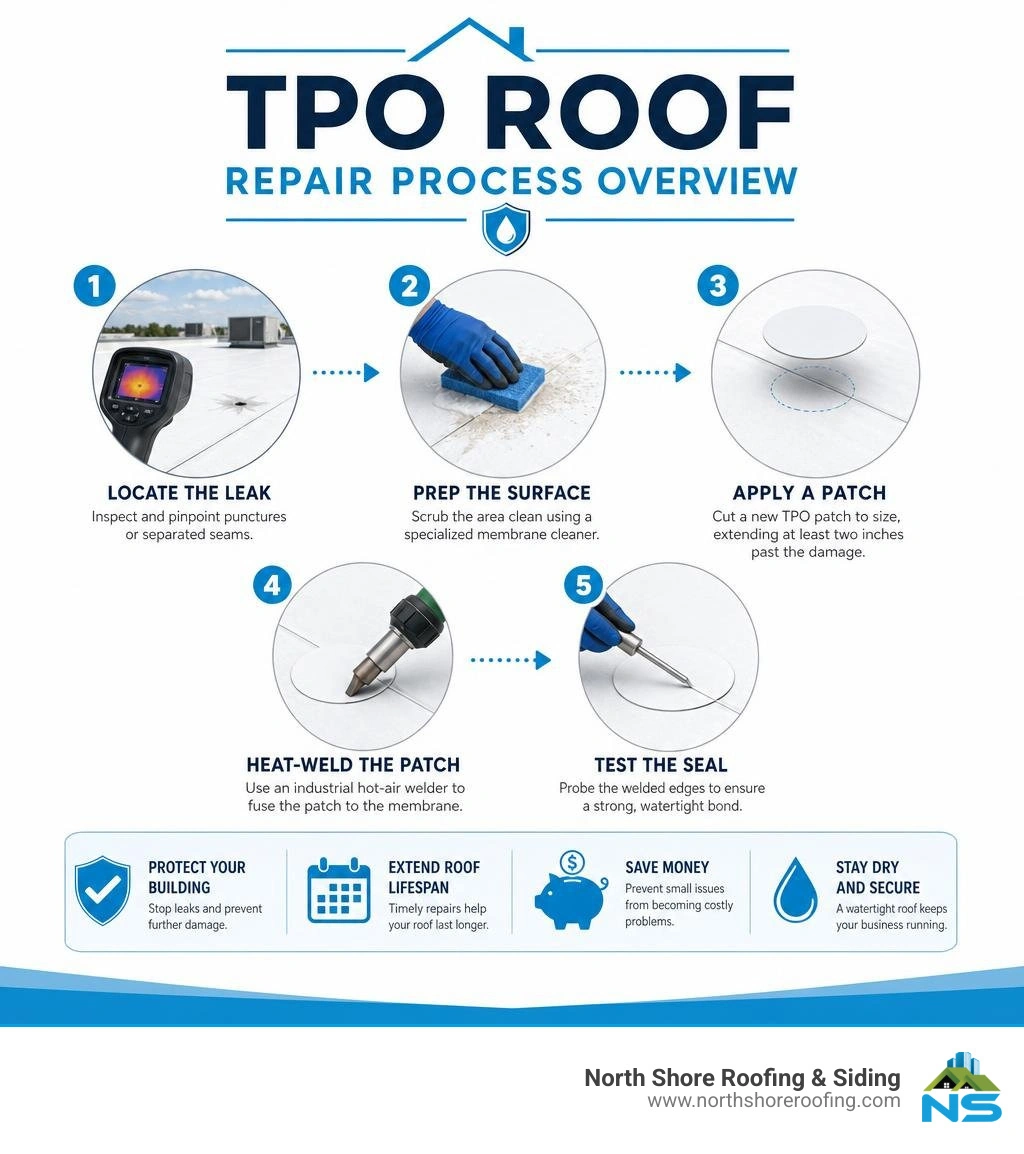
Important tpo roof repair terms:
When choosing or maintaining a flat roofing system for a commercial property in Long Island or Queens, understanding the chemical and physical characteristics of your membrane is crucial. Single-ply roofing has dominated the commercial sector for decades, with thermoplastic polyolefin (TPO) leading the pack as the most widely installed membrane in North America.
However, building owners often confuse TPO with other single-ply options like polyvinyl chloride (PVC) and ethylene propylene diene monomer (EPDM). While they may look similar from a distance, their chemical behaviors, installation requirements, and repair protocols are vastly different. For a deeper dive into these systems, check out the TPO Roofing Guide for Building Owners | Flat Roof Report.
TPO is a single-ply thermoplastic roofing membrane composed of polypropylene and ethylene-propylene rubber polymerized together. It is typically manufactured with a polyester reinforcing scrim embedded between the top and bottom plies to provide superior puncture resistance and tensile strength.
Unlike EPDM, which is a synthetic rubber membrane joined using adhesive tapes or liquid glues, TPO features heat-welded seams. When we perform a tpo roof repair, we rely on these heat-welded seams because they fuse the sheets at the molecular level, creating a continuous, monolithic barrier that is significantly stronger than adhesive-based seams.
TPO also differs chemically from PVC. While both are thermoplastics that utilize heat welding, PVC contains plasticizers to make it flexible, which can migrate out of the material over decades, causing it to become brittle. TPO is naturally flexible and does not rely on added plasticizers, making it highly stable over its service life.
TPO is available in various membrane thicknesses, primarily 45-mil, 60-mil, and 90-mil. The 60-mil membrane is the industry standard for standard commercial applications, balancing cost-effectiveness with long-term durability. To learn more about how these options are integrated into new builds, read our guide on commercial flat roofing installation NY.
The massive popularity of TPO stems from its incredible solar reflectance and subsequent energy savings. A clean, white TPO roof can reflect up to 80% of solar radiation, which can lower your building's cooling costs by 10% to 30%. This is a massive benefit during humid New York summers in Flushing and Bayside.
Furthermore, TPO is highly resistant to mold growth, dirt accumulation, and tear damage. It is also completely recyclable at the end of its lifespan, making it an environmentally conscious choice.
However, TPO does have specific limitations that building owners must keep in mind:
Even the most durable commercial roofing systems are vulnerable to physical and environmental hazards. In places like Port Washington, Manhasset, and Locust Valley, flat roofs are constantly subjected to harsh coastal elements.
Identifying these issues early is the key to executing a successful tpo roof repair before water breaches your building's envelope and damages valuable inventory or equipment. If you need a local certified team in Bayside, working with a manufacturer-certified contractor ensures your warranty remains fully intact and your roof is repaired to the highest standards.
New York weather is notoriously unpredictable. The extreme freeze-thaw cycles of winter cause moisture trapped in tiny cracks to freeze and expand, widening small tears into major leaks. In the summer, intense UV degradation combined with high thermal expansion forces the membrane to stretch during the heat of the day and contract rapidly at night. This continuous movement stresses mechanical fasteners and puts immense tension on roof transitions and parapet walls.
In addition to weather, physical damage is a leading cause of flat roof leaks. Foot traffic from HVAC technicians, plumbers, and utility workers can easily puncture a TPO membrane, especially if tools or heavy equipment panels are dropped.
Furthermore, salt air in coastal areas of Long Island can accelerate the corrosion of metal plates and fasteners beneath the membrane if moisture manages to bypass the top layer. For more technical insights, read about industrial flat roofing NY.
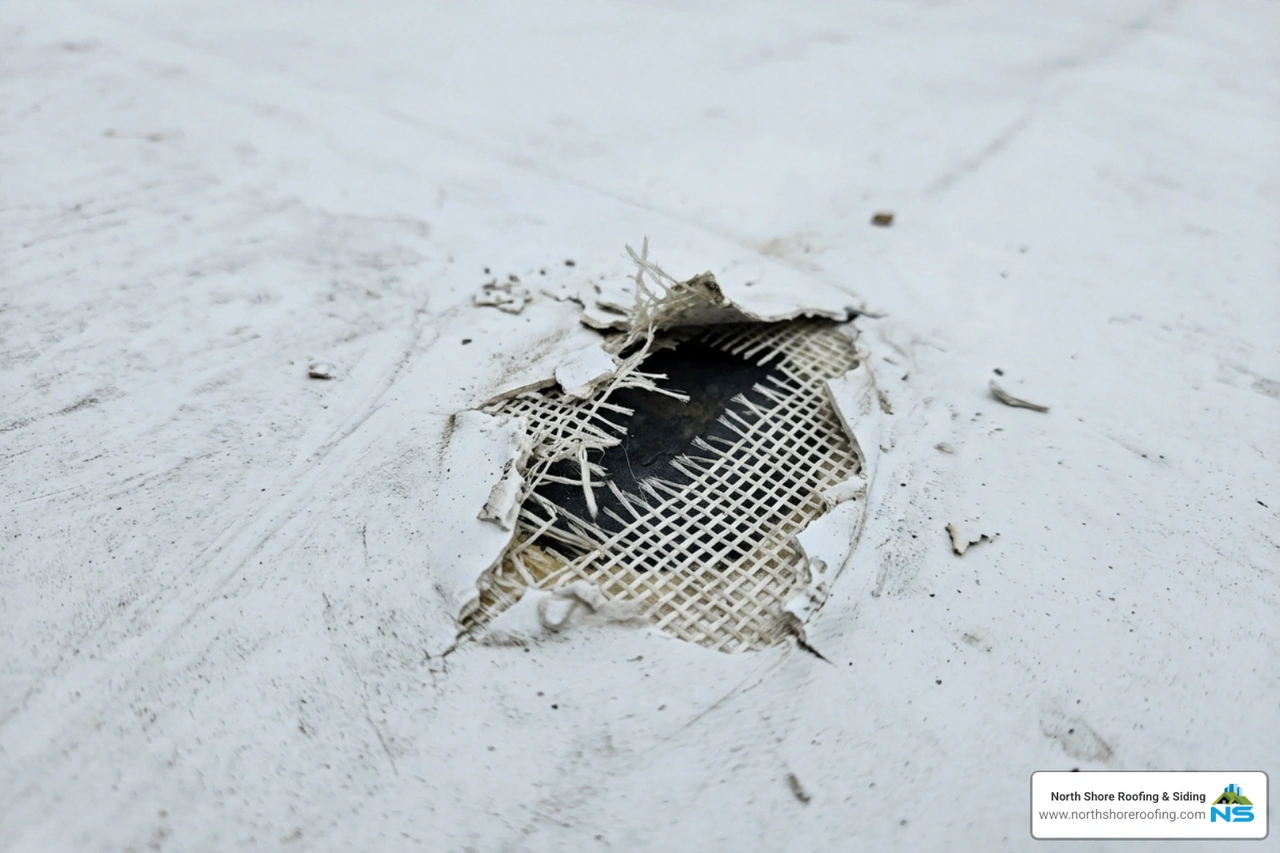
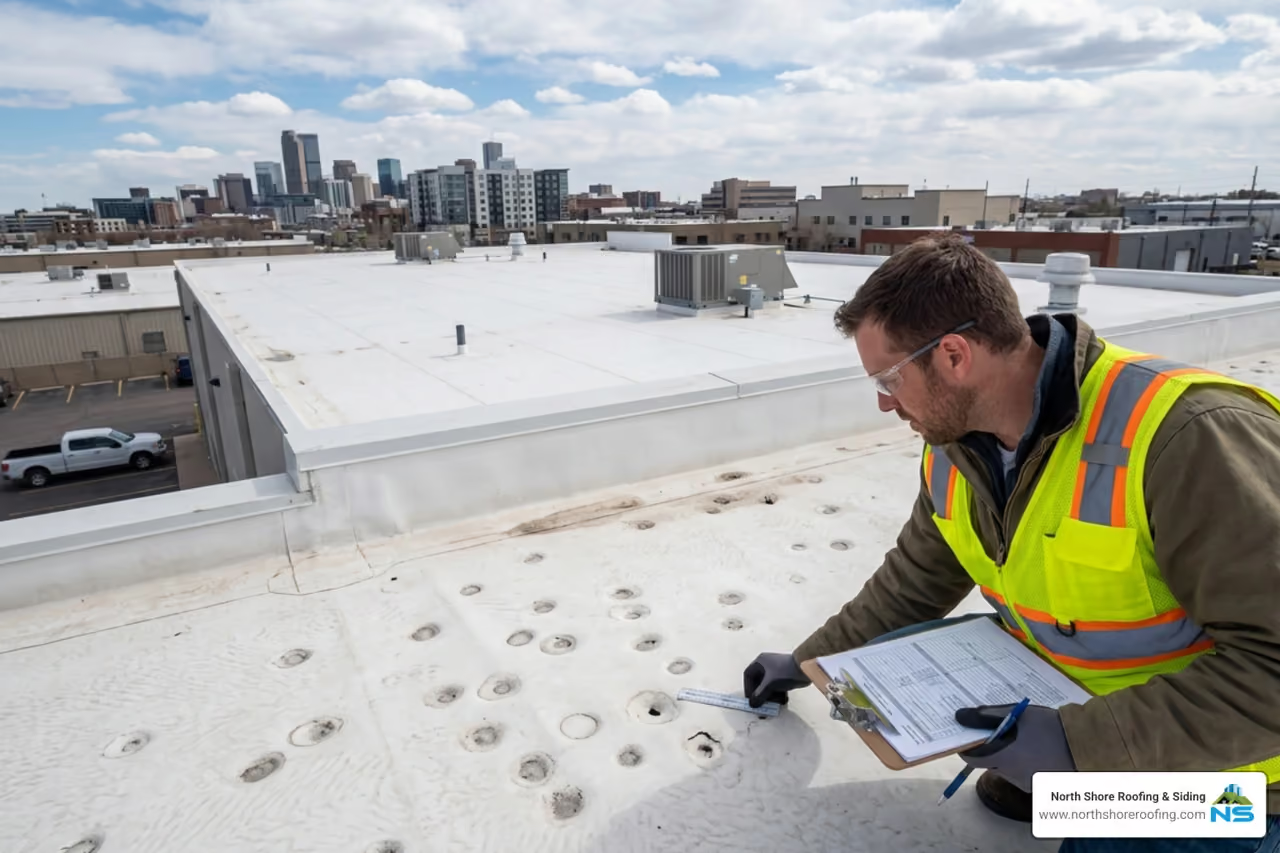
Finding a leak on a bright white flat roof can be challenging because water often travels horizontally under the membrane before finding a path into the building interior. However, there are clear warning signs that indicate your roof needs immediate attention:
When a leak is discovered, the immediate question for any building owner is whether to patch the existing system or invest in a completely new roof. Making the wrong decision can result in thousands of dollars in wasted capital.
To get an accurate assessment in the local Queens area, especially around Flushing, it is essential to consult with highly rated local flat roof experts who understand the specific demands of New York's climate.
As a general rule, a targeted tpo roof repair is the most cost-effective solution if your TPO membrane is less than 15 to 20 years old and the damage is isolated to a specific area. If the rest of the membrane is physically sound, flexible, and has not suffered from extensive UV degradation (which presents as chalking, cracking, or erosion of the top plastic layer), a professional patch will easily restore the roof's integrity.
A targeted repair is also highly recommended if the underlying insulation is dry. We utilize non-destructive moisture detection tools and infrared thermal scans to map out the roof. If moisture is confined to a tiny fraction of the roof surface, we can perform surgical repairs to replace the wet insulation and weld a new TPO patch over the top, adding another 10 to 15 years of service life to the system. For more information, read our article on commercial roof leak repair.
If your TPO roof is approaching the end of its average service life (which typically spans 15 to 30 years, with 22 years being the average), but the underlying deck and insulation are still dry and structurally sound, a fluid-applied silicone restoration coating may be the perfect alternative to a disruptive, expensive tear-off.
Silicone coatings bond directly to clean TPO membranes, creating a seamless, monolithic layer that completely eliminates seams—the primary failure point of flat roofs. Best of all, a complete roof restoration typically costs up to 70% less than a full replacement. To compare standard installation and material costs, you can view the What Does TPO Roofing Cost? [2025 Data] guide.
Below is a general cost and lifespan comparison to help you evaluate your options:
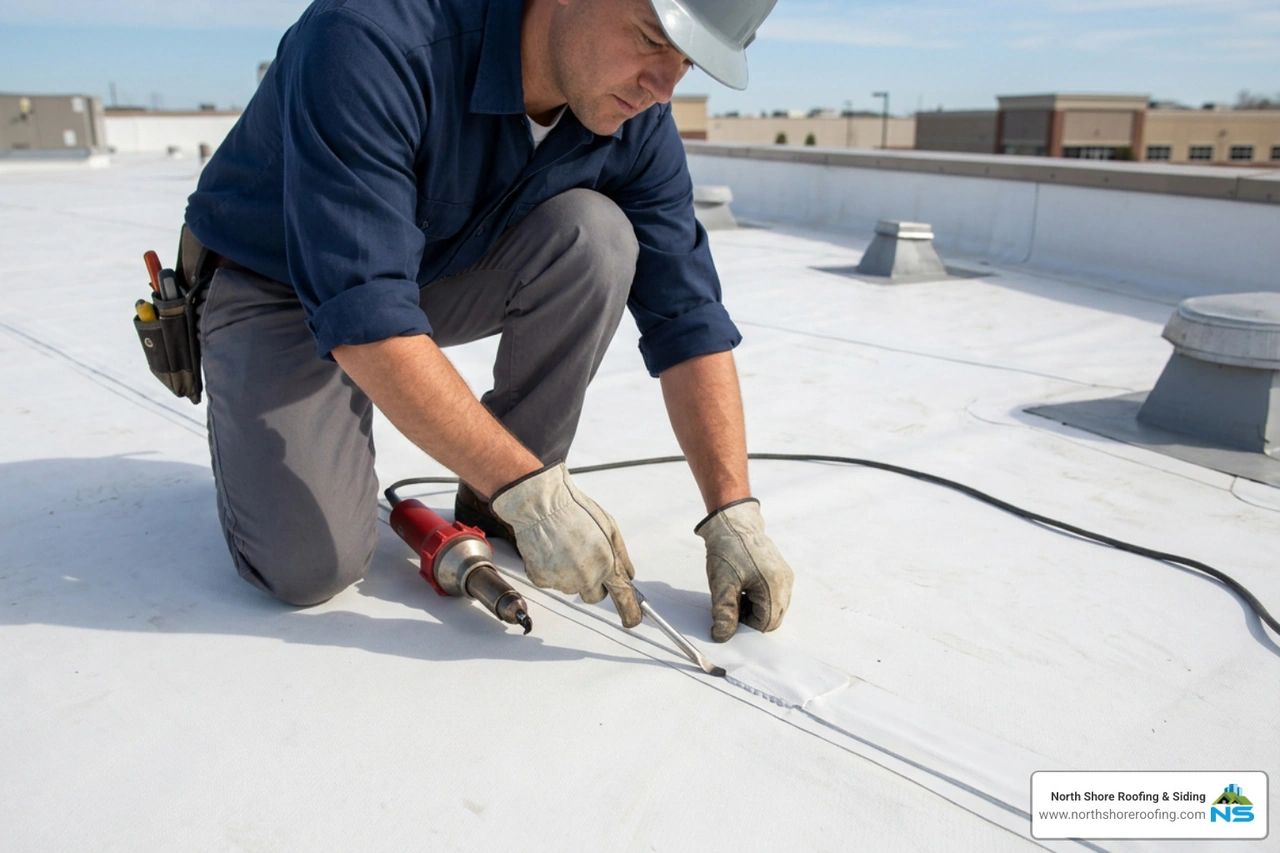
Repairing a thermoplastic membrane is a highly technical process that requires specialized tools and strict adherence to manufacturer specifications. Because TPO chemically changes as it is exposed to UV rays and outdoor elements, welding new material to an old, weathered membrane is not as simple as running a hot iron over it.
To ensure a permanent bond, we follow strict preparation and welding protocols. You can find more details on flat roof upkeep in our guide to industrial roof maintenance NY.
The only reliable, long-term method for repairing a TPO membrane is hot-air welding. Adhesives and caulks will quickly peel away due to the membrane's chemical composition and thermal movement.
Our professional repair process involves several precise steps:
For roofs with widespread minor seam failures or those nearing the end of their design life, applying a fluid-applied silicone coating is an incredible way to restore watertight integrity.
First, we address any wet insulation and reinforce all seams, flashings, and penetrations with a fabric-embedded silicone mastic. Once the prep work is complete, we spray or roll a high-solids silicone overcoat across the entire roof surface. This coating cures into a durable, rubbery membrane that is completely impervious to ponding water and reflects up to 90% of UV rays.
This process can be backed by a manufacturer No Dollar Limit (NDL) warranty for up to 20 years, protecting your investment without the high cost and operational downtime of a full roof tear-off. For more information on commercial coatings, see our article on commercial roof leak repair 2026.
Managing a commercial property comes with plenty of questions. Here are the most common inquiries we receive from building owners in Long Island and Queens regarding flat roof repairs and maintenance.
A professionally installed and well-maintained TPO roof typically lasts between 15 and 30 years, with 22 years being the average service life. The ultimate lifespan depends heavily on the membrane thickness you choose (45-mil, 60-mil, or 90-mil), the quality of the initial installation, and your local climate.
In coastal New York areas like Port Washington and Locust Valley, regular semi-annual maintenance and prompt repairs of minor punctures are critical to reaching the upper limit of this lifespan.
The cost of a tpo roof repair varies depending on the extent of the damage, the height and accessibility of your roof, and whether any underlying insulation must be replaced.
For small, isolated punctures or minor seam lifting, professional repairs typically range from $300 to $1,500. If you require widespread seam reinforcement or a full silicone restoration coating, costs generally range from $3.50 to $7.00 per square foot, which is still a fraction of the cost of a full roof replacement.
TPO is not a DIY-friendly material. Unlike traditional shingle roofs, flat single-ply membranes require specialized industrial hot-air welding equipment that operates at temperatures exceeding 1,000°F.
Attempting to patch a TPO roof with cheap hardware-store caulks, tar, or asphalt-based cements will trigger a chemical reaction that permanently degrades the TPO polymer, making future professional welds impossible and instantly voiding your manufacturer's warranty.
Furthermore, working on a flat roof carries serious safety hazards, especially around roof edges and parapets, which require OSHA-compliant fall protection.
Your commercial property's flat roof is its primary shield against the elements. When leaks or seam failures threaten your building's interior, acting quickly with a professional tpo roof repair is the best way to safeguard your operations and avoid the massive capital expense of a premature roof replacement.
At North Shore Roofing & Siding, we bring decades of local expertise, a fully licensed and certified team, and honest, transparent pricing to every commercial project we undertake. Whether your business is located in Manhasset, Flushing, Bayside, Port Washington, or Locust Valley, we have the specialized equipment and manufacturer certifications required to keep your TPO roof in peak condition.
Don't let a minor leak turn into a major structural headache. Schedule a consultation with North Shore Roofing & Siding today, and let our family protect yours with reliable, high-quality flat roofing services.
Copyright 2022 North Shore Roofing & Siding | All Rights Reserved | Sitemap | Website by Plumb Development a Digital Marketing Agency