Blog Content

16
Jul
2026
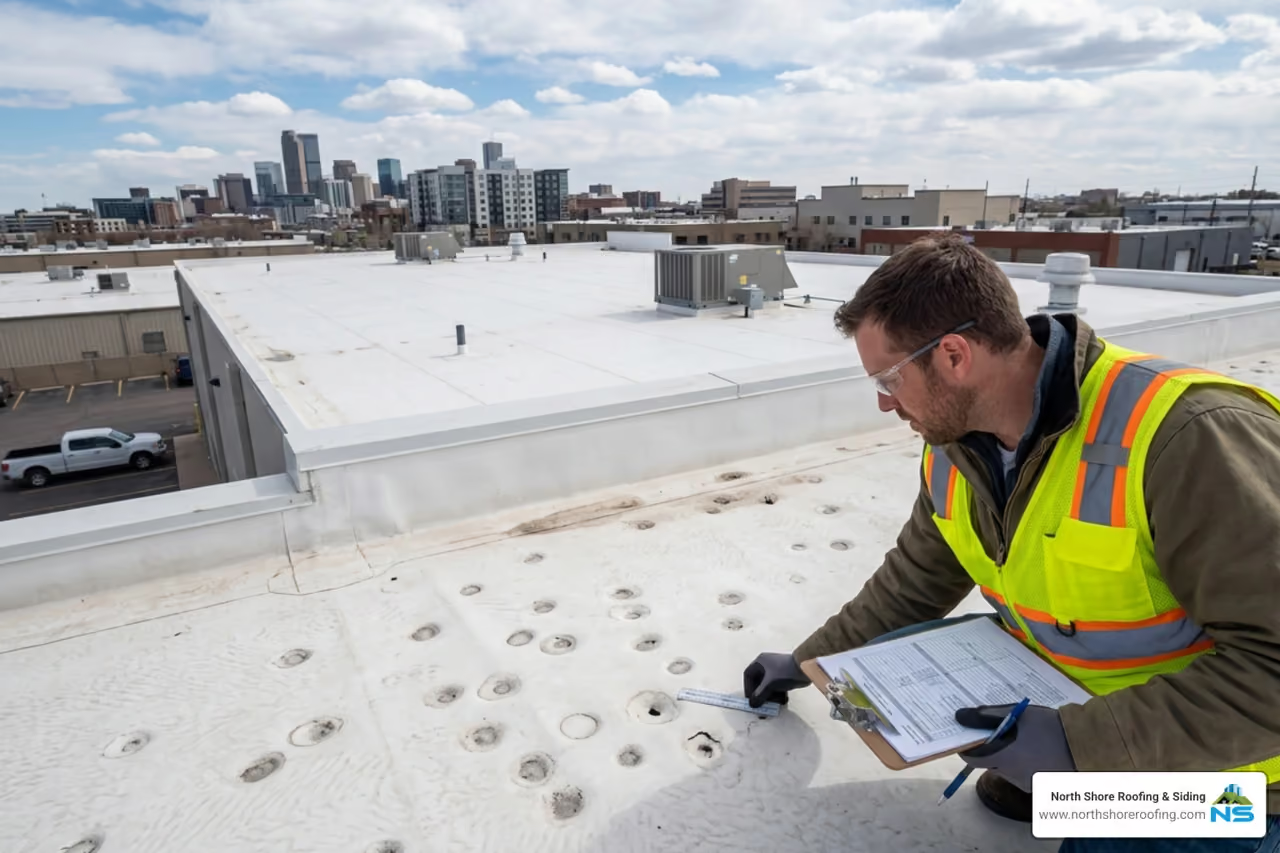
TPO roofing hail damage is one of the most misunderstood problems facing commercial and residential flat roof owners across Long Island, Queens, Port Washington, Flushing, Bayside, Locust Valley, and Manhasset.
Quick answer: What does TPO hail damage look like?
Here's the hard truth: a TPO roof can look fine from the ground and still be seriously compromised.
Standard TPO membranes can resist hailstones up to about 1.75 inches in diameter. But once hail exceeds that size — or once a membrane has aged and lost flexibility — the damage can range from hairline micro-splits to full punctures. On top of that, the most costly damage is often invisible until the next heavy rain or freeze-thaw cycle.
For property owners in Queens and across Long Island, spring and summer storms regularly bring hail events large enough to stress even newer roofing systems. Knowing how to spot the signs early — and when to call a professional — is the difference between a simple repair and a full roof replacement.
This guide walks you through exactly how to identify, document, and respond to hail damage on a TPO roof.
Tpo roofing hail damage vocab explained:
Thermoplastic Polyolefin (TPO) is a single-ply, highly reflective roofing membrane that has captured a massive share of the commercial and low-slope residential roofing market. It’s composed of a polypropylene and ethylene-propylene rubber blend, engineered with a polyester reinforcing scrim embedded between the top and bottom plies. This structure makes TPO incredibly popular for flat roofs in hot climates and urban heat islands alike, because its reflective white surface significantly lowers cooling costs.
In places like Manhasset and Port Washington, where a mix of commercial facilities, industrial parks, and modern low-slope residential estates dot the shoreline, TPO is highly favored. It offers excellent resistance to ultraviolet (UV) radiation, chemical exposure, and ozone. Furthermore, because TPO is installed in wide rolls, it features far fewer seams than traditional systems. When seams are required, they are fused using hot-air welding. This creates a physical bond that is actually stronger than the membrane itself, offering superior wind uplift resistance.
However, no material is entirely invincible to extreme weather. While a brand-new TPO installation can easily withstand standard storm conditions, its vulnerability changes dramatically when giant hailstones enter the picture. The performance of the entire system depends heavily on the thickness of the membrane (typically measured in 45, 60, or 80 mil), the type of underlying substrate, and the age of the roof.
For instance, a 60 mil TPO membrane has been shown to experience up to 40% lower failure rates under equivalent hail impact scenarios compared to a thinner 45 mil membrane. When severe storms roll through our service areas, the physical impact of frozen ice balls traveling at high terminal velocities puts immense mechanical stress on these single-ply membranes. To ensure your commercial property survives these events without costly downtime, understanding the basics of industrial flat roofing NY and investing in professional installations are vital steps.
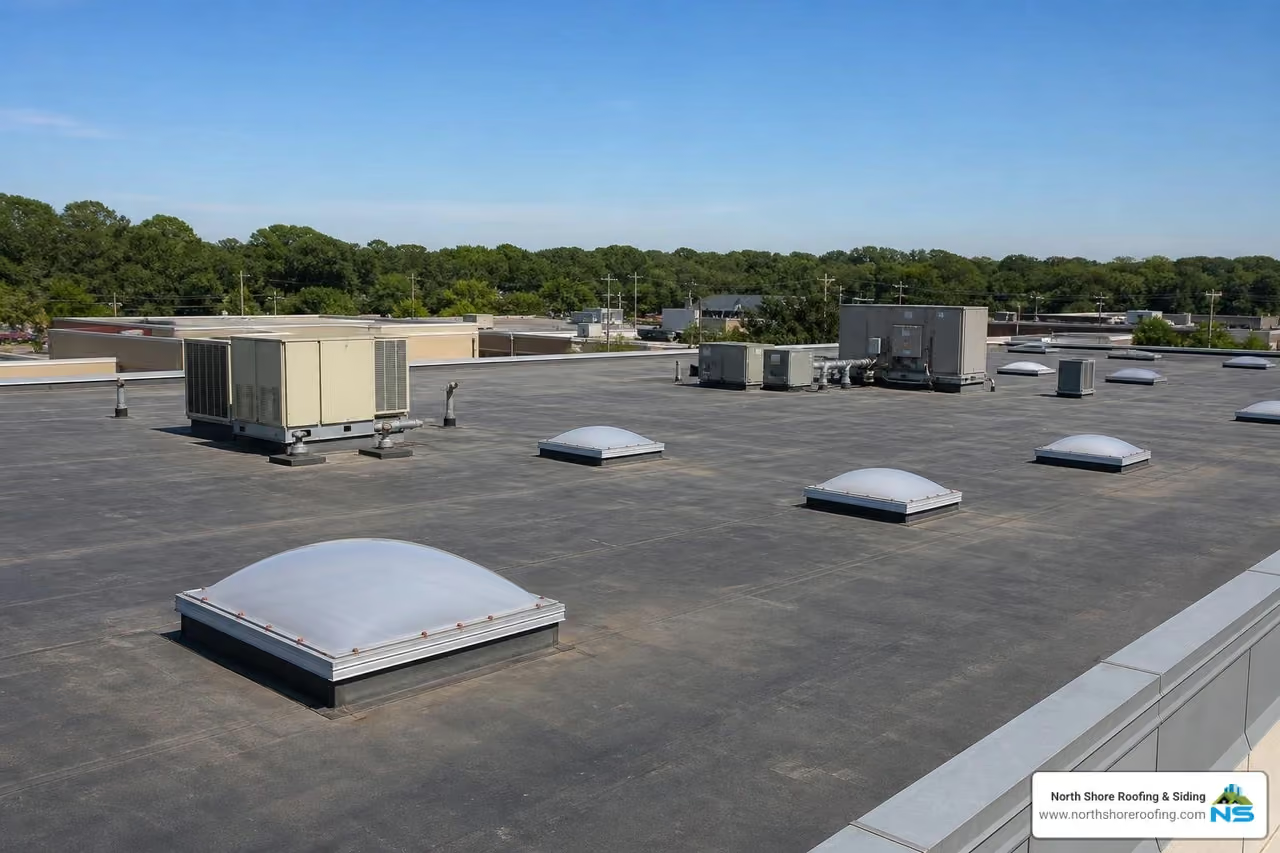
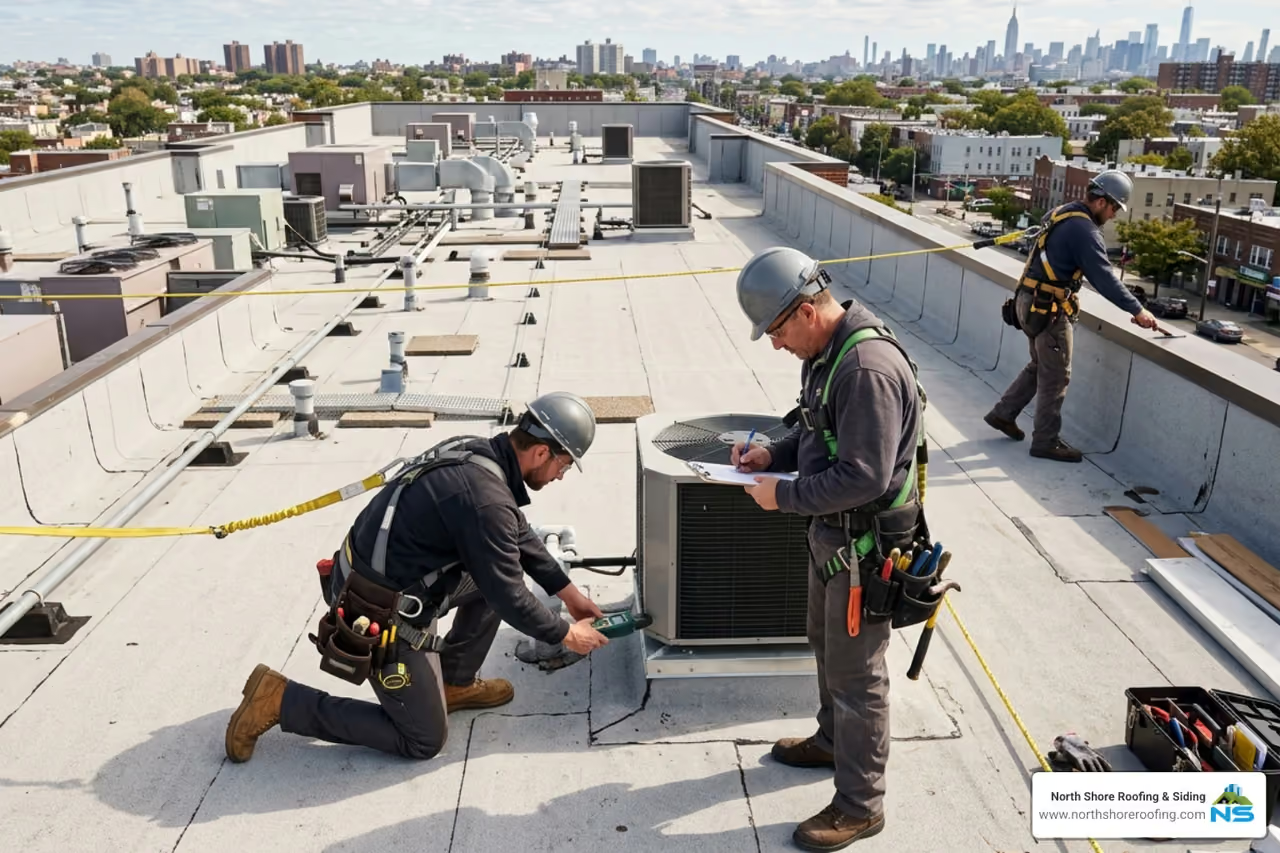
If a storm dumps hail over your property in Bayside or Port Washington, you cannot rely on a simple visual scan from ground level to determine if your roof is safe. In fact, walking a flat roof without professional safety gear and training is highly dangerous. When we conduct a forensic roof evaluation, we look for several distinct physical indicators of tpo roofing hail damage.
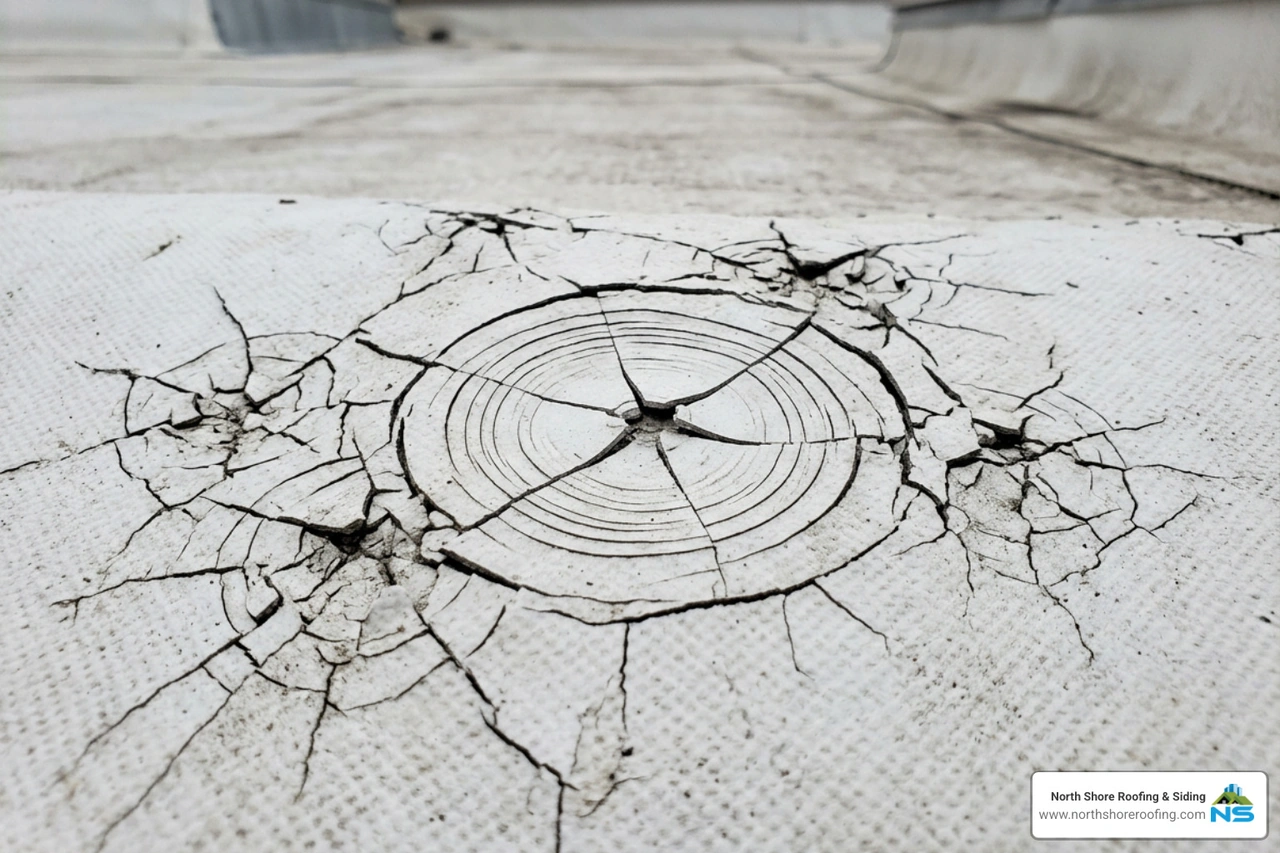
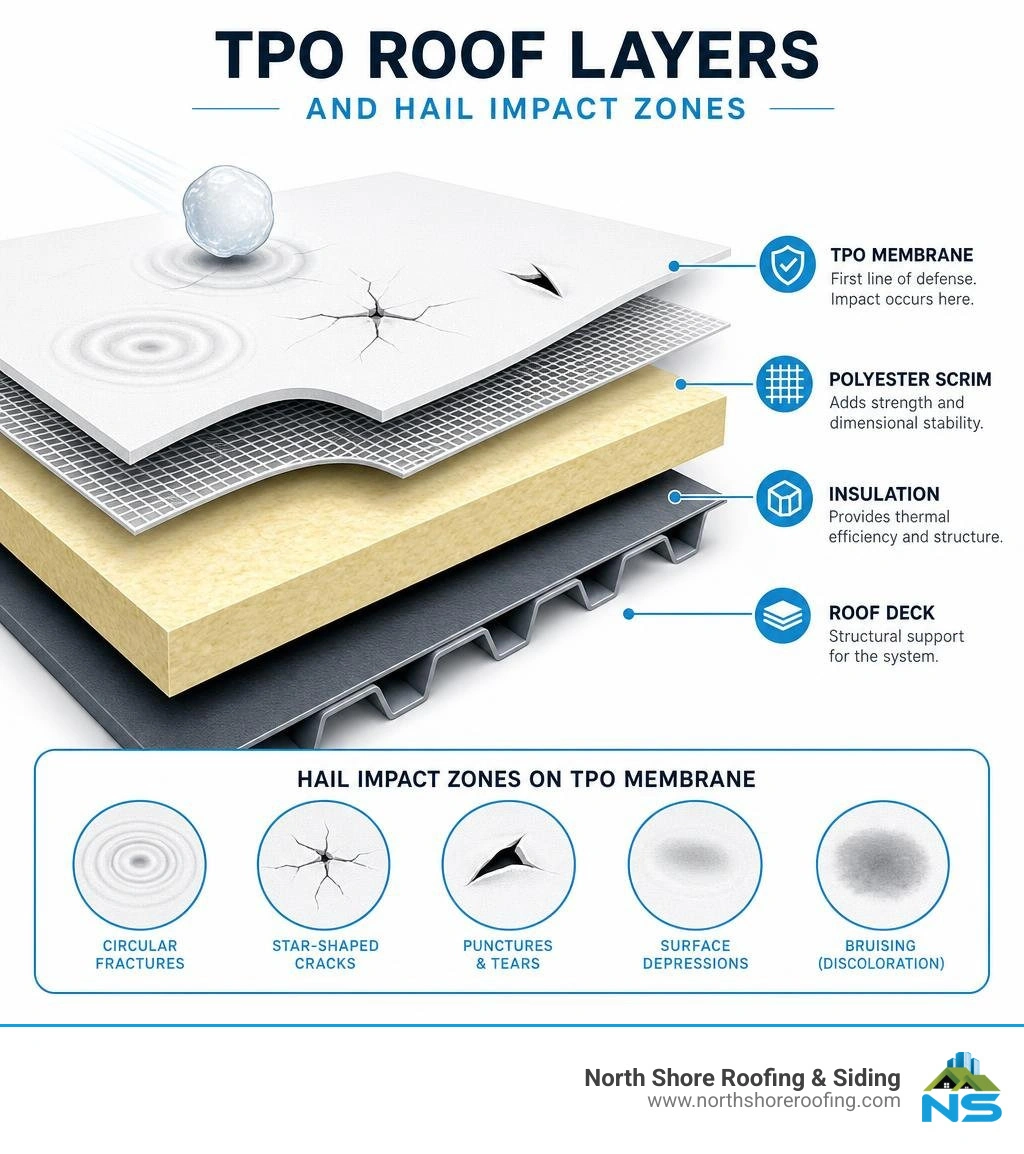
When a dense hailstone strikes a TPO membrane, it causes localized flexing. If the impact energy exceeds the material's elastic limit, it creates circular fractures radiating outward from the impact point, resembling tiny spiderwebs or target rings. Over time, these micro-cracks expand, eventually splitting the top ply completely.
Large, jagged hailstones can physically punch holes straight through the membrane. This is especially common if the hail hits directly over a mechanical fastener plate or a rigid seam. Micro-splits may also develop along the roll direction. Interestingly, forensic studies have shown that some older TPO formulations fail by splitting along the roll length due to tension forces and a loss of elasticity, a condition that can be exacerbated by the sudden cold shock and physical impact of a hailstorm. Learn more about identifying these structural failures in the comprehensive Hail Damage to TPO Roofing: Identification Signs & Commercial Claim Guide.
TPO consists of a top white weathering layer, a middle reinforcing polyester scrim (mesh), and a bottom dark layer. When hail fractures the top weathering layer, it exposes the woven scrim beneath. Once the scrim is exposed to UV rays and pooling water, it acts like a wick, absorbing moisture and distributing it throughout the roof system, leading to rapid degradation and active leaks.
A hailstone doesn't have to break the TPO membrane to cause functional damage. A heavy impact can crush the underlying polyisocyanurate (polyiso) insulation or fracture the gypsum cover board beneath. This creates a soft spot, often called a "bruise." When you step on these areas, they feel spongy. Over time, the membrane stretched over this compressed void will fail due to foot traffic, temperature swings, and pooling water. If you notice signs of water intrusion or soft spots, securing a professional commercial roof leak repair 2026 is critical to stop moisture from spreading.
The severity of tpo roofing hail damage is determined by a complex interaction between the storm's characteristics and the roof's structural assembly. To understand how these variables interact, let's look at the baseline thresholds:
Not all hail is created equal. Soft, slushy hail contains trapped air and collapses upon impact, absorbing its own energy. Hard, supercooled, high-density ice stones act like solid rocks. When combined with high winds—such as the 100 mph wind gusts observed in historic Midwestern and East Coast storms—the kinetic energy of the impact increases exponentially. This horizontal driving force causes severe damage to vertical transitions, flashing, and parapet walls.
As TPO membranes age, solar radiation and thermal cycling cause plasticizer migration, making the material brittle. A 10-year-old TPO roof in Flushing or Locust Valley may fracture under 1-inch hail that a brand-new roof would easily survive.
Furthermore, the substrate beneath the membrane plays a massive role. If the TPO is installed directly over soft insulation, it has very little support and punctures easily. If it is installed over a high-density gypsum cover board (like DensDeck), the rigid backing absorbs and distributes the impact energy, protecting both the membrane and the insulation. Roof pitch also matters: flat, low-slope roofs take direct, 90-degree hits, absorbing the maximum possible kinetic energy, whereas sloped roofs experience glancing blows. To review the engineering physics behind these impact dynamics, see the Scientific research on TPO membrane deformation.
When dealing with commercial property insurance, you cannot simply tell an adjuster, "My roof was hit by hail." Insurance carriers require objective, verifiable, and forensic-grade evidence to approve a full roof replacement. For building owners in Long Island, Queens, and Manhasset, the documentation process must be handled with scientific precision.
Our team uses a structured, multi-step inspection protocol to build an indisputable record of storm damage:
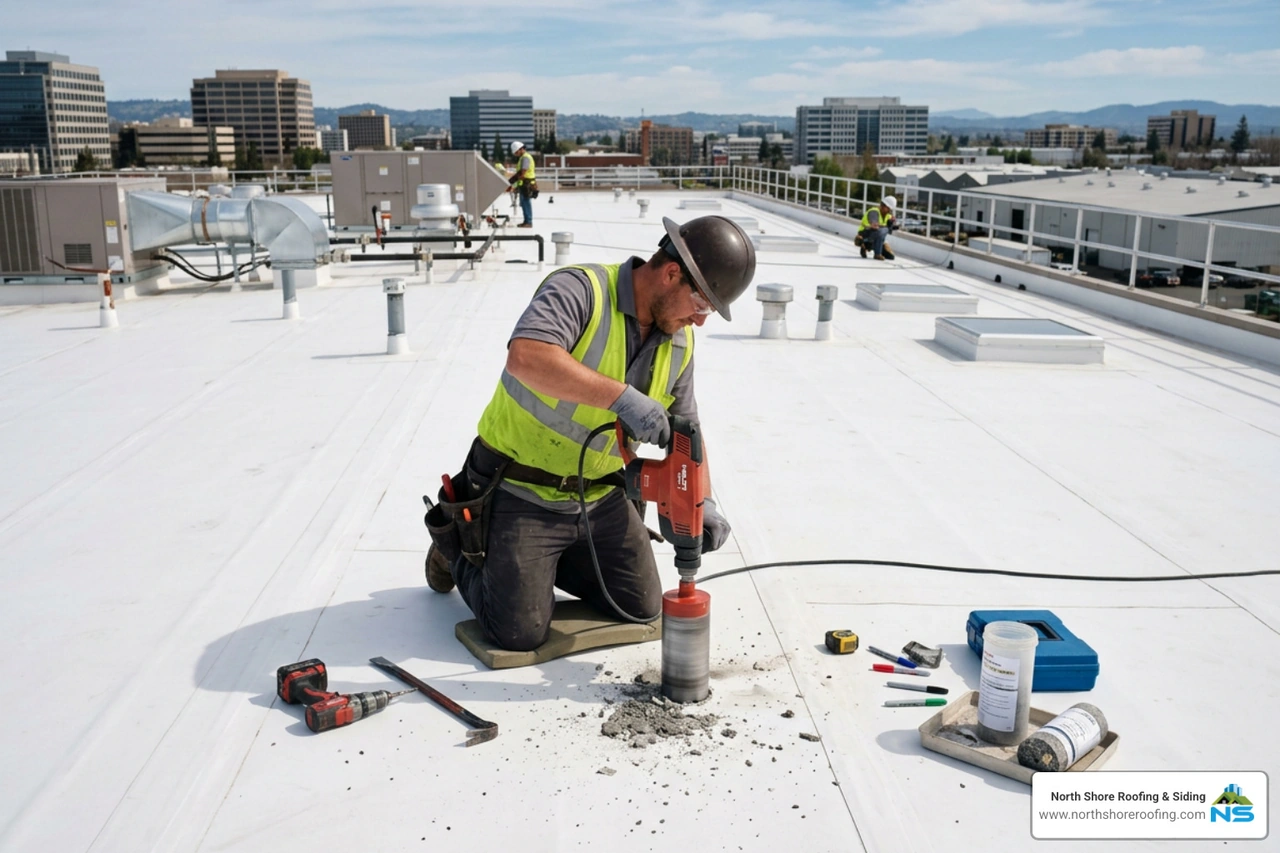
Furthermore, we correlate our field findings with certified meteorological weather data and historical storm reports. By matching the physical impact patterns on your roof to documented hail sizes and wind speeds on the specific date of loss, we eliminate any arguments regarding pre-existing wear and tear. This level of detail is essential for verifying compliance with international testing standards, such as those detailed in the Assessment of Impact Damage in Fully Adhered Commercial Roofing System. For long-term protection, regular industrial roof maintenance NY is the best way to ensure your documentation remains up-to-date.
Once tpo roofing hail damage has been identified and documented, property owners must choose the most cost-effective and structurally sound path forward.
If the roof is relatively young, the membrane remains flexible, and the damage is limited to a few isolated punctures, spot patching is a highly viable option. This involves cleaning the damaged area thoroughly, cutting a rounded patch of matching TPO material (to prevent corners from peeling), and hot-air welding it over the puncture.
However, we must warn property owners: patched TPO roofs can experience up to a 340% higher rate of follow-up leak claims within three years compared to fully replaced membranes. This occurs because the physical welding process applies intense heat to an already weathered membrane, which can create localized stress concentrations and future weak points.
If a specific section of the roof—such as a localized valley or a single bay—sustained heavy damage while the rest remains pristine, we can cut out the damaged section, inspect the underlying insulation, replace any crushed boards, and weld a new sheet of TPO into place.
When the damage is widespread (e.g., more than 10–15 punctures per square) or the underlying insulation is heavily saturated and crushed, a full replacement is the only honest and long-term solution. During a replacement, we recommend upgrading the roof assembly to maximize future storm survival. This includes:
By upgrading your assembly to meet FM 4470 (Factory Mutual) or UL 2218 Class 4 impact ratings, you not only protect your building but often qualify for significant discounts on your commercial property insurance premiums. If you are ready to explore your options, our team specializes in professional commercial flat roofing installation NY tailored to the unique climate demands of Long Island and Queens.
Functional damage—which refers to damage that compromises the roof’s ability to shed water or shortens its expected lifespan—typically occurs when hailstones reach 1.75 to 2 inches in diameter. While smaller hail (around 1 inch) can cause cosmetic dimples or scuffs, it rarely fractures a newer, flexible TPO membrane.
However, the impact velocity is a major factor; a 2-inch hailstone falling in high winds can strike with enough energy to puncture the membrane and fracture the gypsum deck beneath. For a deeper dive into how different hail sizes impact single-ply systems, read What size of hail will damage a TPO roof?.
As TPO membranes age, they lose their initial flexibility due to continuous UV exposure and thermal expansion and contraction. Over a period of 5 to 16 years, some older TPO formulations can become brittle and highly susceptible to cracking.
An aged, weathered TPO roof can easily fracture or split under the impact of 1-inch hail—size thresholds that a newly installed, elastic membrane would easily tolerate. To learn more about how aging dynamics increase your storm vulnerability, check out Hail Damage TPO: 5 Deadly Signs & Fixes.
Surprisingly, no. Comprehensive laboratory testing conducted using ASTM C518 steady-state thermal transmission protocols has shown that hail-caused dents in polyisocyanurate (polyiso) insulation have no measurable effect on the R-value of the insulation.
The thermal performance differences measured before and after denting fell within the +/- 2% accuracy limits of the heat flow meter testing equipment. However, while the thermal R-value remains intact, the physical crushing of the insulation still represents structural damage because it weakens the support system beneath the TPO membrane, making it highly vulnerable to future puncture.
When a severe hailstorm rolls through Long Island and Queens, protecting your property requires fast action, precise documentation, and professional expertise. Whether your building is located in Flushing, Bayside, Locust Valley, Manhasset, or Port Washington, ignoring hidden roof damage today can lead to catastrophic leaks, compromised insulation, and denied insurance claims down the road.
At North Shore Roofing & Siding, we bring decades of local expertise, a fully licensed and certified team, and a commitment to honest pricing to every single project. We don't just patch over problems; we thoroughly inspect your entire roof assembly to ensure it can withstand the next major coastal storm.
If you suspect your commercial or flat residential roof has sustained storm damage, don't wait for the first leak to appear. Contact us today to schedule a comprehensive, professional forensic inspection and experience the peace of mind that comes with our premier Commercial Roofing Services NYC.
Copyright 2022 North Shore Roofing & Siding | All Rights Reserved | Sitemap | Website by Plumb Development a Digital Marketing Agency